Interview by Jazz Zhu, Edited by Draculeia L. Sewick
ACCELERATOR is Los Angeles Performance Practice’s flagship artist development program—a nine-month intensive that empowers multidisciplinary artists to build sustainable, visionary, and self-determined creative careers. A thoughtfully-selected cohort of twelve Los Angeles-based artists meets bimonthly to engage in professional development workshops, in-depth mentorship, and peer accountability to design a resilient creative life. By the end of the program, participants will have artist statements that celebrate their whole selves, a personalized strategy for resourcing their practice, and a sustainable approach to producing the work they’re passionate about.
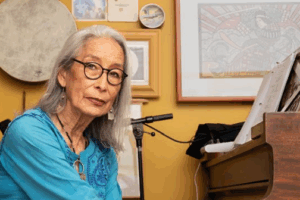
ACCELERATOR cohort member Nadene Pita is a Māori interdisciplinary performance artist and musician who synthesizes a breathtaking sound bouquet of contemporary-intercultural music, experimental jazz, and a unique voice. She’s best known for her electroacoustic project, “Wood, Wire, and Bone,” which expresses themes of family, nature, lineage, and intersectional feminism through innovative aural and visual forms. After being awarded a 2023 Emerging Artist Fellowship by the California Arts Council, she returns to Los Angeles Performance Practice as part of ACCELERATOR. In this interview conducted by Jazz Zhu, Nadene reflects on her early relationship with dance and music, the tension between balancing advocacy for others with advocacy for herself, and her experience as an immigrant artist in Australia and America.
For those who don’t know you yet, how would you introduce yourself?
My name is Nadene Pita, and I am an indigenous interdisciplinary musician. I work primarily with music, but I also work with movement, visual art, and other mediums. And I collaborate with other artists and other disciplines. I enjoy that a lot.
What was your upbringing? How did you get to where you are today?
I was born in New Zealand. My dad is Māori, and my mom is Irish and English. We moved to Australia when I was seven, so I actually started ballet when I was about five over there. I’d been asking my mom to do it for a couple of years, and she was like, “You should wait until you’re a little bit older.” And it was a very long wait, but I started with dance first. When we moved to Queensland, the Gold Coast, I went to the local primary school. I was doing ballet, and then I started playing viola in the orchestra when I was about eight. At that school, it was free to have private lessons, and on Fridays, we would spend a couple of hours playing together.
So I had access to playing in that kind of ensemble since I was really young and started classical training around that time. I eventually went to college and did classical viola, but my second study was voice. And I’d never really sung before, but it was Jazz Voice. I was just curious about it, and I’ve always loved Sarah Vaughn, particularly. I discovered her and was really interested in the texture of her voice, which was magical to me. And I found within a couple of years that I wanted to change and do Jazz Vocal. I changed [studies] to being a singer, and worked with some really great musicians in Sydney, where I moved when I was 21.
The other thing that really had a big impact on me when I was a child was that my dance teacher was Kathleen Gorham. She was a prima ballerina, one of the first in Australia. And she was in the first Borovansky dance company, which became the Australian Ballet Company. She was Russian-trained, so she was really rigorous and pretty tough, but she kind of took me under her wing. I think she came from a working-class background like I did, and she was quite quiet, and I reminded her in some ways of herself. She was very kind to me and would always give me scholarships to do camps and things like that.
So, she gave me a lot of encouragement, and I became very serious about classical ballet. Even though, as a person of color, she told me, “You can’t actually be hired to do this. They won’t hire you because of your skin color; it’s not going to be something they’re going to want to have on stage with the blue lights. You won’t look the same.” And that was the reality. Things in America progressed at a different rate than in Australia. And she was right. I kind of came to the conclusion that if I wanted to do dance, I would need to go and move to America. So, yeah, I eventually found my way to jazz and, being a musician.
But having these two backgrounds of classical music and jazz, which were just really distinct, didn’t really come together. Over time, through knowing other musicians who were making their own music and sort of encouraging me to start, I realized that it might be interesting to try to integrate playing with singing. Even though viola was not really traditionally seen as something you improvise with, I started doing that. I met other people in Sydney who were into experimental improvisation and exploratory music as well, and became involved in a sort of community playing with people who were exploring that sort of performance.
It all came together when I decided to make an album. That was really when I found that I did have an artistic voice that was fairly unique.
I know last time we talked, you said you were teaching or… You recently quit?
I am still teaching, and I intend to finish out this year, which is part of a contract that my organization has with a school and me. I want to honor that as much as I can. I think this year, being part of ACCELERATOR, I have increasingly become aware that I wasn’t really following through with watching where my energy goes. I’m just doing too many other things that make it nearly impossible for me to do art. So that’s been something that I’ve been working on this year throughout this program, trying to make space to do things that I feel that I should be doing as well.

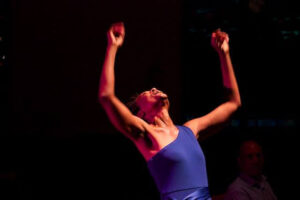
A concert for David Ornette Cherry and the Organic Notes Band at The World Stage Performance Gallery, Inglewood
Could you share a little bit about your personal journey and what things are taking away your energy or your time that you could have used to create?
For me, I think that my energy has been going into teaching. I have been teaching ever since I’ve been in Los Angeles, involved in nonprofits, and teaching for underserved communities with large group classes of up to 30 children. And now I am doing that for a general music class. It’s half an hour to 40 minutes with a class, and then 5 minutes between the next class. You do get a break, but for me, it is really exhausting. I think that I need to look at doing another kind of teaching if I continue, because I don’t think I have that ability that some people do. I know people who have performing careers while they’re teaching full-time. But I’m not one of those people who can do that.
I did make a choice to stay in the nonprofit world for that reason [to serve the underserved] because I feel more connected to communities like the ones that I grew up in Australia. I was an immigrant, and I was from a working-class background. We didn’t have unlimited resources. So I prefer to be in that similar kind of community now, and I feel that I make the most impact in those communities, but I also feel that after doing that for a good fourteen years now, I’ve given a lot. And I don’t think it’s necessary for me to keep giving in the same way. I think, as long as it’s worthwhile for whoever it is and you can tie in your personal values and things like that into what you do, then that’s wonderful.
So you’re staying with the school until at least the end of the school year. And after that, what do you envision your life to be?
Yes. I am thinking more about moving into healing arts or social-emotional arts facilitation. I do have a certificate in that. So I’d like to do more of that in other communities and also, sort of on a personal level, work with clients myself rather than having a setup where I’m working in a school and part of that system.
Earlier, you talked about being an immigrant in Australia and in America. What has the experience been like being an immigrant artist here?
I found it trickier than I expected. I think over the 20 previous years that I’d been doing my artistic practice in Sydney, I’d built up a community of like-minded artists with whom I worked a lot. So when I came here, I didn’t really realize that I would be starting from zip again. It’s such a different place to be an artist. Los Angeles is spread out, and some people just stay on their side of the city and never go out of it. As an artist, you have to travel all the time to make connections and be involved in different hubs of art. It’s hard. My daughter, she’s grown now, but when we first moved here, she was at the end of elementary school. She was my main priority.
And I don’t regret that being my life, establishing a new family here, because I got married to an American. That was my priority at that time. When I was younger, I could go out late at night and meet people, make those connections that you make as a young artist, a lot easier than when I was working towards having a stable family life. It’s just something that we all try to navigate in different ways, but I found that it affected the way that I also moved in this new community. So, it was tricky to make connections, to find gigs and work, and a place where I felt I could do what I need to do as an artist and grow.
And after the past 15 years, do you feel like you have found a community in Los Angeles?
I think I am definitely making more connections. Part of that is ACCELERATOR. So, that has been wonderful. And previously, before that, I got a fellowship, which was the first one that I had gotten at all. The California Arts Council Fellowship, which Los Angeles Performance Practice rolled out. They organized lots of events where I could meet other artists who were part of that fellowship. I think that was a really important time for me to broaden contacts and opportunities.
Other than making connections, is there anything else that you came to ACCELERATOR for? How has that experience been going for you?
I really have been enjoying the sessions we’ve had. It’s very helpful to be in a group of people who are striving to make their creative life front and center of what they’re doing. I’m enjoying what it is, and enjoying learning about different artists and the way they are approaching their practice. And I like how there are a few people in each discipline, but we all share whatever our particular journey is looking like at that time. It’s fascinating and informative too.
In recent years, there have been more Native American playwrights and productions in the country, especially in LA, because we have Native Voices and a lot of amazing Native artists doing great work. We have seen a rise of Native artists doing performance work, but sometimes that doesn’t extend to Indigenous communities that are from the rest of the world.
I think I understand where you’re going with this, but it’s always been my experience where I’ve lived as an immigrant, whether it’s Australia or here, that the Native peoples from that place deserve and should be granted access to support for what they’re doing creatively. So, I fully think that Native people from Southern California need more than they get, and that what they have is really important.
I think as someone who’s outside that, as an Indigenous immigrant, it’s interesting. I’ve made connections with Native artists from this area, and also internationally with other Indigenous people. Even while I’ve been here, I am more and more getting connected to people who are artists and cultural practitioners who are Māori in Los Angeles. Should I have access to other ways of support, being supported as an artist? I think that’s great. If there’s anything that can assist in evening the playing field for people of color, that’s really important.
But I think that Native people, along with Black people, must be given opportunities. I guess I’m just used to working outside of that because that’s the way I grew up as an immigrant. And certainly, being Māori, I did not, when I was younger, even connect that with my practice. It’s become more and more important, but it was something that I grew up feeling not positive about. So, to feel like I can embrace that now has been a really beautiful process for me.
And I think that because I acknowledge this part of me so much now, I integrate it into my artistic practice through playing instruments, and also just my contemplation and expression as an artist. I feel that if I am in any way recognized, that side of who I am is also recognized. Whatever way I move forward, it will be as an Indigenous person. But I don’t feel unlucky that I’m not Native American or don’t have access to the things they have access to, because I want them to have what they have and more.
I think it’s so beautiful that when people move across the world, we bring our roots with us. Be it language, music, or art, and wherever we land, our culture also takes root in the soil, and it blooms into something so beautiful. Are you able to find hope in this current climate?
It’s a very challenging time. It’s very distressing and difficult, even as an artist, to find ways of processing what is happening. It’s challenging and devastating for so many people, and to see so many people in such fear and so many lives impacted. It’s very sad, but I do find hope in continuing to try to go through. I really feel like being an artist is a process. It’s not just that there are projects and things like that that have starts and endings.
But it is pretty much about: What are you navigating at the moment? How are you navigating it? And what is your process of finding ways of being and offering something to others and to yourself? I find it difficult when it is such a traumatizing time for so many, and there is also a need to pull back from the trauma. That’s valid, as well as confronting it – whichever way we choose to do it. I am trying to write, play, and do things around what is happening in the country.

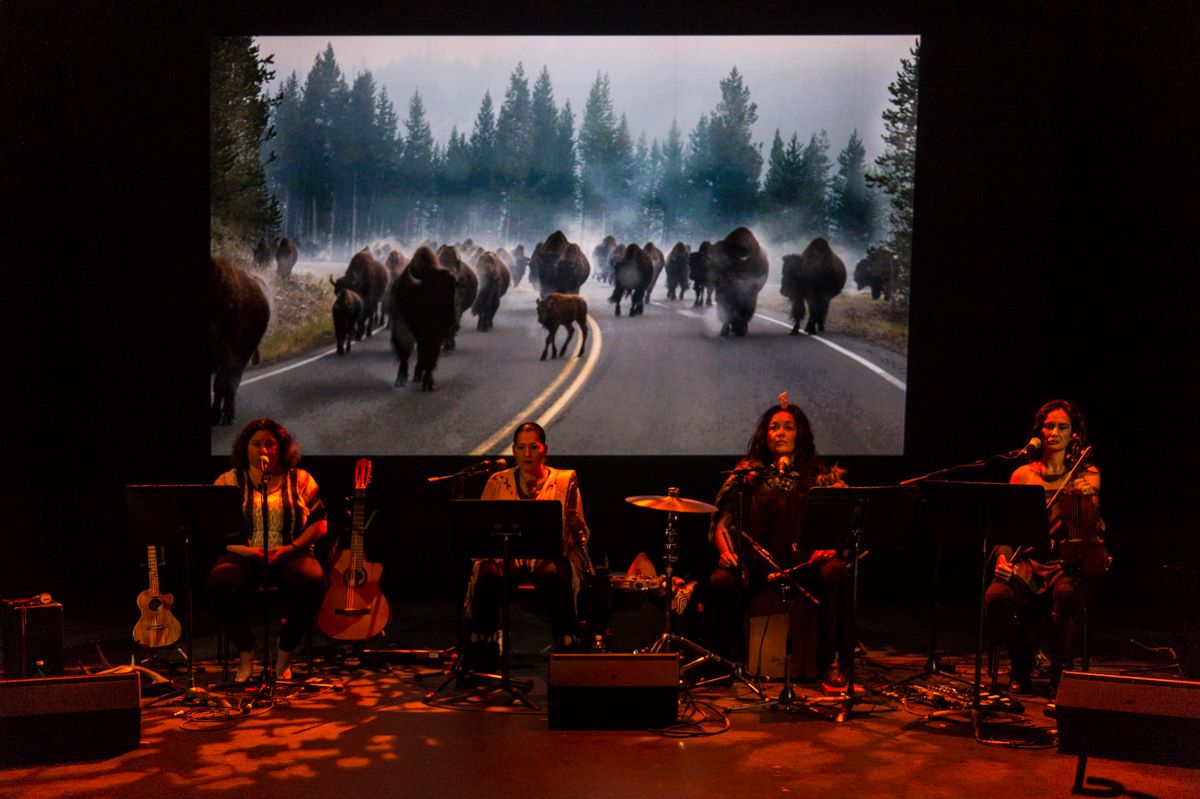
A multidisciplinary concert produced by Red Sky Performance featuring four acclaimed Indigenous women musicians
Making art is resistance. Art is activism.
Yeah, it is absolutely. And it’s always a struggle, too.
I think any artist is very familiar with struggling, with things or ideas appearing one way and, in practice, finding them to be different. The disconnect between our logical reasoning brain and our experience is something that artists deal with all the time and have to find ways through. I think artists are more geared towards finding ways through this kind of predicament that we culturally find ourselves in than other professions in some ways.
And maybe I’m saying that could be because I’m an artist, but I think the way that we are looking culturally and in society at the functions of our lives and the structures that we try and fit ourselves into are not holding. So we need to be open to other ways. And I do think that people of color also have an interesting, different way of being because they don’t have regular access to what is the norm.
With a couple of minutes left, I’d like to end the interview on a positive note so we don’t leave with heavy feelings. What are you looking forward to?
I’m looking forward to continuing to find ways of living the life that I feel like I was meant to live. Of the heart. And I’m looking forward to letting go of expectations that no longer serve me, and continuing to grow and learn. There’s so much to learn, always. And so much to explore.
Nadene Pita (she/her), a Ngātiwai/Ngāpui musician and interdisciplinary artist, weaves contemporary, intercultural music and experimental jazz, using voice, viola, Māori instruments and electronics with dance, film and theater. Her electroacoustic project “Wood, Wire and Bone,” blends taonga puoro, intercultural music, jazz, contemporary dance, and video. It is a reflection on themes of family, nature, lineage, and intersectional feminism; addressing systems of power and privilege, challenging patriarchy, racism, and capitalism. Collaborations with Tibetan monk Lama Tashi Norbu blend the sacred with the experimental, extending to performances with the late David Ornette Cherry, saxophonist Louis Van Taylor and engagements with Indigenous Arts Company, Red Sky Performance. Her album “Turning Arrows into Flowers”, infused with South Pacific harmonies, Māori chants, chamber improvisations and eclectic influences, reflecting her Pacific roots and mixed ancestry. Recipient of the 2023 Emerging Artist Fellowship by the California Arts Council, Nadene’s art transcends conventional boundaries. Her work includes healing-centered arts, integrating experience as a music, dance and meditation teacher for underserved communities including Youth Orchestra LA, Education Through Music-LA and Let’s Dance It Out. Her art, rooted in mindfulness and cultural reverence offers audiences and participants transformative experiences. With an MA in Contemporary Cross-Cultural Improvisation, Nadene navigates musical realms guided by heritage, innovation, with commitment to cultural dialogue and social justice.