Interview by Jazz Zhu, Edited by gina young
ACCELERATOR is Los Angeles Performance Practice’s flagship artist development program—a nine-month intensive that empowers multidisciplinary artists to build sustainable, visionary, and self-determined creative careers. A thoughtfully-selected cohort of twelve Los Angeles-based artists meets bimonthly to engage in professional development workshops, in-depth mentorship, and peer accountability to design a resilient creative life. By the end of the program, participants will have artist statements that celebrate their whole selves, a personalized strategy for resourcing their practice, and a sustainable approach to producing the work they’re passionate about.
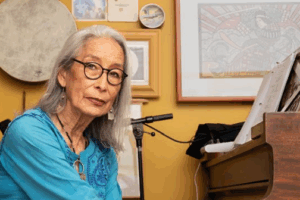
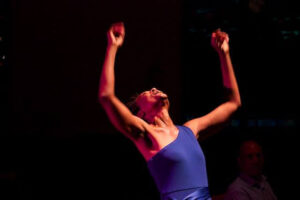
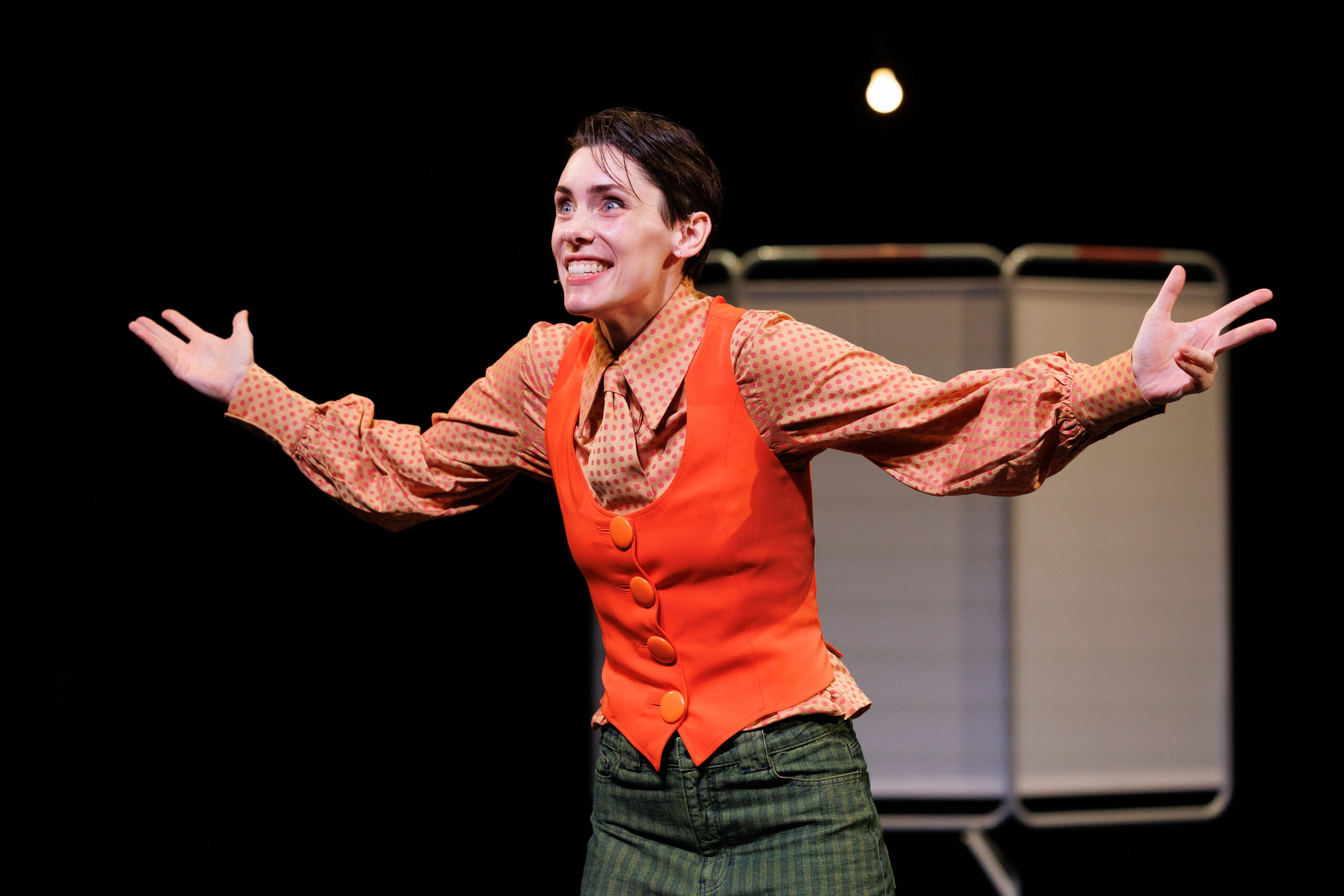
Sophia Cleary (she/her) is an interdisciplinary artist focused on performance and liveness. Making her work through the lens of the fool, or trickster, Sophia uses play as a method and critical position to engage her audience in a system where power dynamics necessarily shift. In this interview, Sophia shares with Jazz Zhu about comedy, vulnerability, and, of course, power.
For those who don’t know you yet, how would you introduce yourself?
I’m an interdisciplinary artist. I make work across performance, video, sculpture, drawing, installation… but my primary subject matter is performance itself, as an expanded field. I grew up as the child of actors. I witnessed from a very young age how theatricality seeped into the domestic sphere. So I feel like I make work about the slippage between theatricality and the real, like where that seeps into our everyday life.
What was having a family of actors like?
My mom really tried to make it for a while. She was on Guiding Light, which was the soap opera in the ’80s. But because of my parents’ humble upbringing and financial circumstances, they weren’t able to continue pursuing the arts as a career path. So, they kind of had to give it up. And because they understood how hard it was and how it’s such an industry of rejection, they really dissuaded me from trying to be an actor at all.
Yet they continued doing community theater, because they love acting and they didn’t really care if they were going to make it or not. They just wanted to be able to play these sort of interesting, challenging roles that they weren’t going to get on Broadway. We did plays together sometimes, like we did a play where they played a husband and wife and I played this young girl. Then when I got to high school, I just became a troubled teen [and I didn’t pursue acting anymore.] But by the time I got to college, I started studying dance and I got really into movement and choreography , and the history of dance and and improvisation. And that led me to do an MA in performance studies at NYU.
What led you to the art you make now?
I was doing experimental performance dance stuff, but then I kind of realized I was really funny and I didn’t feel like the dance world could hold how much comedy I had to offer. So, I started doing standup regularly once I moved to LA. And I really consider those years such a great boot camp and training for finding one’s voice on stage. Writing in real time, working with an audience in a regular capacity. I got into the clown scene too out in LA. And that and that was sort of this arrival where I was like, “Oh my god, this is what I’ve been searching for for all these years.” Clown is kind of like the final boss. You really do have to have thick skin to do that kind of work.
So, it’s been a winding, strange road to where I’m at now. I basically consider all of my life experience part of my practice. For many years, I worked as a birth doula. I worked for a private investigator. I’ve been an educator. I’ve been a waiter. All of those dynamics come with really specific scripts for interacting with people. And that definitely plays out in my work.
You worked as a birth doula?
Yes! I was like, what do you mean like I don’t need medical training and I could attend a live birth? Like, what? But it is very demanding and it didn’t really align with wanting to be a performer, because I was trying to perform again and you can’t really be like, sorry I can’t come to your birth I have a gig, you know? But birth is basically the coolest thing you could ever witness. It completely changed my life, and my relationship to the idea of parenthood and motherhood and my own body.
Does it connect to other aspects of your practice?
I work with a lot of other artists. I have my own workshop called REHEARSAL, which is a works-in-progress performance series. And I work with a lot of artists one-on-one and that doula work translates because it’s like I’m helping people through the pain and joy and excitement and nerves of birthing something. But, instead of a baby, it’s a piece of art.
When people give birth, it is a sacred occasion, and you created the REHEARSAL series to help other artists give birth to their art, which is also such a sacred process. I just love that little connecting dot. Where do you think your humor, your comedy comes from?
It definitely comes from my parents. They’re really funny and dry. It also helps that I am a stellium Gemini. And I’m a Sagittarius rising. So astrologically I have a lot of clown energy in my celestial imprint, but only LA audiences and/or gay people will care about me saying that. But yeah, having actor parents, there’s always kind of a state of play that’s at work. And the flip side of that is that there’s also always a state of, like, intense depression and self-hatred. But their perspective on things, I don’t know if they would articulate it this way, but they see things as a performance, so I learned to see things as performances. And that doesn’t mean it’s inauthentic or not real, but they were really good at noticing people. Especially my dad. His ability to make really astute hilarious commentary is is something I have inherited.

Are you the first person in your family to start clowning?
To my knowledge, yes.
Do you have a clown persona?
There’s no persona for me. I think of it more as a lens. I really wanted to become a fluent improviser. To be able to make bits or offerings and just have them completely fail and bomb and then learn how to recover from that with grace. I think that is what clowning is about. And it’s about developing a comfort and capacity to handle being in the unknown, which I think is a skill we could all develop.
In your own work, you’ve acted as a mentor to a lot of other artists. What brought you to LAPP’s ACCELERATOR program? Were you looking for some sort of mentorship yourself?
I feel like in order to be a good mentor to people, I have to keep learning and getting new resources so that I can share resources, too. I’m so happy to share resources and let people in on what worked for me or didn’t, or what my process is. And I feel like what ACCELERATOR offers is a chance for a cohort to meet for that very purpose. Share resources, talk about our experiences of things that worked or didn’t work, or tips and tricks for this or that. I really need help with the business side of my practice, which is not a unique problem or position, but I am just at the point where I knew I needed to level up and I wasn’t going to be able to do that alone. So this came at the perfect time and it has given me an infrastructure to keep applying to all of this stuff every other week, you know, it gives me that motivation and I’m learning so much from the workshops. It’s the kind of things that nobody teaches you.
Have you been updating or editing your Artist Statement after the ACCELERATOR workshops?
Oh yeah, constantly. It’s like constantly changing. I have a spreadsheet now with all different types of working artist statements. And also because I’m genreless and I traverse these different worlds, there’s like some Artist Statements where I do need to address and center my work that is couched firmly within the visual arts versus a statement that’s more about my theatrical positioning or something.
Oh yes, you got an MFA in visual art.
When I was looking at theater MFAs, it felt like the wrong direction for me because it was actually very conservative training, you know, of becoming an actor or a director and I just felt like damn, you know, I’m an artist. I’m too weird to want to become just solely one of these roles or to become so defined. I’d rather just be an artist that gets to play with what those roles mean. I also wanted to expand my practice into the visual arts and see if I could continue to address the same questions that I address in my performance work, which I feel I have been able to do, and deepen. I think some people come to grad school to really double down and get more specific. For me, it was more of a broadening and an opening up. So maybe that was a huge mistake. I have no idea. For me, it’s felt very personally rich, but you know, chances are what feels personally rich for me is professional suicide. So, I don’t know.
You said you were able to broaden your scope of practice, but you were still able to investigate the same questions. What are some of the questions you’re interested in?
My practice has really been about relationships and a performer’s relationship with their audience and that power dynamic. Starting from there, that’s really expanded into, what are the conventions and protocols of a given architecture and how do those function as scripts where then we cast ourselves with specific behavior? I come into a theater, okay, great. I know exactly what it is I’m supposed to do as an audience member, and I’m kind of like, how can we push against those scripts? And if we can start transgressing the scripts given to us in the theater, then how can we get comfortable enough with the discomfort of that to do that outside of the theater, too? As an artist, I’m deeply invested in exploring power and our always-shifting roles. Whether it’s the director, the actor, the audience or the mailman and me or something, you know, all types of relationships and how these fluctuate in terms of who feels like they’re in charge or who feels more vulnerable.
In closing, how about we each share two or three things we’re looking forward to?
You can start.
I am very, very looking forward to living in a country without gun violence. I am also excited to go home and be able to speak my dialect again because here I don’t have that community. And last thing, I’m looking forward to just kind of, inspired by you, the connections and the relationships I have with people wherever they are.
That’s beautiful. I’m excited for you for all of those things. I guess for me it’s continuing to work with the artists who I work with in the capacity as kind of like a sherpa doula dramaturg kind of person who walks side by side with them in their process. I get so much out of it, and it’s really beautiful to witness and hold. And I’m excited to continue deepening my own practice and hearing back from these millions of things I’ve applied to. And just simply I really look forward to watching the birds outside my window every morning. There’s a whole gaggle of them and they’re so funny and they love eating the fennel seed in my front yard and it’s just really grounding to be with nonhuman beings and just care for them in the way that I can and just watch them thrive.

Sophia Cleary (she/her) is an interdisciplinary artist focused on performance and liveness. Making her work through the lens of the fool, or trickster, Sophia uses play as a method and critical position to engage her audience in a system where power dynamics necessarily shift. In her live performance work, she focuses on the space between performer and audience as an aperture that both restricts and expands, deploying humor as a lubricant to mirror, respond to, or disrupt the status quo. Throughout her practice, she addresses the stakes of live performance and lays bare its attendant contracts and procedures. Sophia has presented her work in Scotland at the Edinburgh Fringe Festival, in New York City at the Center for Performance Research, Danspace Project, The Chocolate Factory, Dixon Place, and The Kitchen, and in Los Angeles at the Hammer Museum, MoCA, and Human Resources Gallery. She is the founder and coordinator of works-in-progress performance series REHEARSAL, where she has advised over 75 performing artists in the development of their work. She holds a BA in Dance and Art History from Marlboro College, an MA in Performance Studies from NYU Tisch School of the Arts, and is currently an MFA candidate in Visual Arts at UC San Diego. Contact: sophiacleary.com