
By Jazz Zhu, edited by gina young
ACCELERATOR is Los Angeles Performance Practice’s flagship artist development program—a nine-month intensive that empowers multidisciplinary artists to build sustainable, visionary, and self-determined creative careers. A thoughtfully-selected cohort of twelve Los Angeles-based artists meets bimonthly to engage in professional development workshops, in-depth mentorship, and peer accountability to design a resilient creative life. By the end of the program, participants will have artist statements that celebrate their whole selves, a personalized strategy for resourcing their practice, and a sustainable approach to producing the work they’re passionate about.
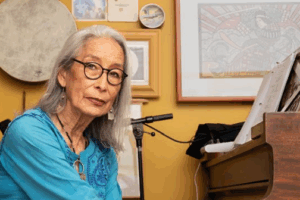
Crystal Sasaki (she/her) is a Butoh dancer and multidisciplinary performance artist based in Los Angeles. Her works combine movement, text, and audiovisual poetry in an ongoing investigation of dreams, communication, heritage, animism, and healing in our hyper-mediated world.

Photo by Intisar Abioto, 2017
Please introduce yourself for those who don’t know you.
My name is Crystal Sasaki. I’m a Butoh dancer and a performance artist and an audiovisual poet, and I live in Los Angeles. I teach Butoh and Deep Listening practice, and other somatic movement and relational work.
Beautiful. What was your upbringing like? What’s your background?
My upbringing was a little eclectic. I’m mixed race. I’m half Japanese-American and half Swiss-French-American. Both sides of my family are from the Bay Area for about three or four generations. I grew up though mostly in Southern California. And then I went abroad. My mother started a nonprofit humanitarian foundation; she was doing humanitarian aid efforts in Thailand, in Indonesia, in Kenya. So I grew up on the road in a lot of different cultures and being homeschooled. It’s definitely something that has weaved into my practice as an artist. Then I was back in San Diego for a few years, finished high school there and then moved back to the Bay Area and came up in the DIY punk, East Bay art scene.
In what ways do you think your unique upbringing has shaped your artistic practice?
I think, for one, the awareness of body language and communicating nonverbally affects a lot of the dance practice that I do. There’s a lot of nonverbal communication going on, and I think growing up with that as a regular practice for survival made it a language that I understand and tap into well. And then also being around a bunch of different cultures, I saw a lot of different ways of being and living and a lot of different art forms and performance forms, especially dance/theater being ritual performance and spiritual performance, really integrated into daily life and communities. I think that I approach my work as a bit of ritual theater and with that kind of community element and everydayness. Also a grassroots DIY-ness. The work that my mother was doing in communities with people was very grassroots, volunteers building things up, and we were in villages where people were living in a much more DIY, of the earth, kind of way. I try not to use a lot of resources. I don’t like to spend a lot of money on the work, because I think there’s something really rich about just figuring it out in the scrappier kind of way.

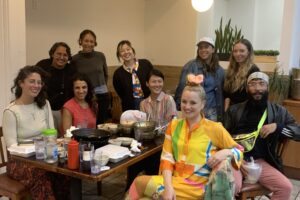
Photo by Miles Pflanz, 2025
While you were traveling as you were growing up, did you also start your dance training?
Before we went traveling, I did ballet quite seriously. Like five days a week, on pointe shoes when I was like six, which they shouldn’t have put me on. So I was very serious about ballet as a young, young child. And then when I was traveling abroad, I took some Balinese dance classes, since our base was mostly in Bali. Some Thai dance classes. And then I was exposed to a lot of world art, world dance forms. But it wasn’t until my early 20s that I came back to dance.
And how did you discover Butoh?
Through the art communities that I was a part of: experimental film, performance art, punk music, noise music stuff. I started looking at performance art and discovered Artaud and discovered Butoh kind of through that. I was searching. I was like, I miss dance. I love dance. I started taking ballet classes and modern classes at the community college again, but I didn’t really identify with formal company dance style. I was looking for something more experimental. So I was just poking around, doing my own research, and I found Butoh. First through the work of Eiko and Koma. They don’t 100% identify as Butoh artists, but they come from that lineage. I saw their work and it really spoke to me. And also with my Japanese-American heritage, I could feel it. It was pulling at strings of ancestral whispers, like it was a way that I could relate to my Japanese heritage as a young, crazy punk kid. I was like, oh, I understand this language.
Have you been able to travel the world because of Butoh, sort of continuing your childhood?
I would love it if being a Butoh performer paid for me to travel around the world. I am actually going to be going to Japan in the fall with another Butoh artist, so that’s amazing. But whenever I do travel, I make sure to find the Butoh people wherever I am. So I’ve studied in Europe, in Italy and in Berlin and Germany, in England, Japan, Mexico. But those were more like personal trips that I looped into my study.
So, Butoh first emerged in Japan around 1950.
Yeah, it was post World War II. And it was a bit in response to that, in response to the mixing of cultures. It started as more of a performance art form, like Tatsumi Hijikata, who’s one of the founders of the Forum, along with Kasu Ono. He was in the contemporary dance world in Japan at that time. The Fluxus people came over. John Cage came. It was a dialogue, the performance art and contemporary dance world. It was a lot of happenings, like protest performances, stuff like that. Really loud, big, naked, screaming type of energy. And then he slowly kind of returned back to Japan. And so it became mixed, quite mixed with, like, Japanese folk arts and an animist perspective and philosophy and kind of moved into its own form. Some people really directly correlate it as a response to the bomb or the war, but it was a lot more than that. It was more of a cultural moment of change. And it’s a lot of processing, I think, of really complex emotions that came out of that time and a lot of grief. And trying to reconcile Western philosophy and Japanese philosophy and find a new form, a new theater form, a new dance form.
When you are studying or performing Butoh, what kind of feelings or thoughts emerge for you?
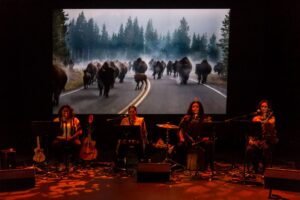
A lot of internal reckoning, reconciliation. There’s a big catharsis and processing aspect to it. It’s a little channely. I try to empty myself. This is some of the philosophy behind Butoh, as well, is like emptying the body of the ego and the self, and allowing the dead or ancestors or collective consciousness or your subconscious to move you. So a lot of the time, it’s a very abstract experience for me. I’m sort of following my own body. I’m not super conscious, like, “I’m gonna make this move. I’m gonna do this thing. I’m enacting this feeling.” I work with scores sometimes or poetry. It’s usually connected to the natural world and mythology. Trying to embody different animals or natural phenomena or different sort of mythological stories, archetype type things. If I’m doing a Butoh work that I’ve created or a performance work that I’ve created, there’ll be a lot more intention around that. But a lot of the time these days, I’m doing improvisational sets with musicians and really just trying to tap into the moment. I’m working with whatever is in the room. I’m working with the day. I’m working with what I’m moving through personally. And what it feels like is going on in the world at the time.

Photo by Intisar Abioto, 2017
The craft of Butoh is different from the Western European lineage of dance, which is very, very structured and hierarchical.
There’s many forms of Butoh and in the more traditional sides of Butoh, there is more hierarchy. There is a lot more choreography than what I do. So take what I’m saying more as my personal practice of Butoh and not what Butoh is in general. But yeah, there is a lot more. There’s a lot more interest in the emotional experience of the moment. It’s more about the emotionality around the movement and the primal aspect to it than, like, entertainment or, like, athleticism necessarily. Even though some Butoh dancers are extremely athletic, it is really hard. It can be really intense on the body. There’s a lot of moving slowly and really intricately as well as evoking an intense emotion. There’s a cathartic aspect to it that can push the body to its limits.
And you’re also teaching?
I studied Deep Listening which is coming from the musical lineage of Pauline Oliveros. She was a composer and she did a lot of early tape music stuff in San Francisco and she created a set of scores in collaboration with a group of other people, improvisational scores. There were scores for musicians to improvise and she made albums that way. But she also made open sonic meditations that were meant to be done by anyone. You don’t need musical training; I don’t have musical training. So I come to the form as a dancer, not as a musician. It’s mostly musicians that practice this. But it’s another improvisational practice that’s really focused on tuning into the moment, listening to yourself and the people around you. I would teach workshops that were a mix of all of these things. We would do some Deep Listening practices, we would do some Butoh warm up exercises, and then other somatic scores that I was making up or co-making up with people. I did that regularly in Portland and I’m not doing that currently. But I’ve been teaching Deep Listening workshops. I’m officially a Deep Listening facilitator now, certified. So I’m hosting Deep Listening workshops and then trying to host some specifically Butoh workshops. I want to try to teach more Butoh in LA. There’s not that many opportunities for people to learn. But it’s a new thing for me to be trying to hold and teach that lineage.
Do you have a favorite exercise?
An example of an exercise that I think is really accessible and is practiced in both Butoh and Deep Listening, actually, and is sort of just like a Buddhist meditation practice: slow walk. It’ll be mixed with different imagery. Sometimes it’s like you’re walking towards your future or there’s 10,000 years of your ancestors and your past. Different teachers will come up with different imageries to hold the imagination. It’s almost like acting strategies. It’s walking as slowly as you possibly can and just feeling every part of your foot as it goes down and lifting and having each step when you lift your foot up as important as putting your foot down and just being present with the walk. Doing that for like 20 minutes. You get into this state. It’s a very meditative practice and it really brings you into awareness of your body. It’s very grounding.
A lot of Butoh work is sort of like… there’s a lot of facial mask… the mask of the face and holding these different expressions. The open mouth is a big one, and the eyes… It’s a bit insane, but it’s getting a sort of comfortability with that side of humanness. The grotesque and the strange, grief, the insanity, the silliness. It’s a little bit of physical theater and a little bit of meditational practices and then training the body.
Another example is that you move a marble. You imagine there’s a marble that goes into your tailbone and it moves up your spine slowly, slowly, slowly, all the way up and pops out the top of your head and then goes back. Stuff like that. Or you’ll do partner exercises where, if you and I were partnered up, I would maybe pull an imaginary string here and that would move you. It’s a lot of isolation work and trying to gather that kind of control over the body.
Thanks for demonstrating the exercises. It’s funny because when you tell someone, oh, I’m a dancer in LA, they immediately go, oh, do you dance for Lady Gaga?
I know. It’s fun. LA’s dance scene… I’m still kind of trying to understand. It’s different because of Hollywood and the entertainment industry and all of that. I don’t even necessarily say I’m a dancer that much anymore because, yeah, people assume you’re doing ballet or hip hop or heels. Heels, yeah! Though I do love ballet.
I want to circle back to something we talked about earlier, which is connecting with your cultural heritage through dance. I think Japan and the United States have had very complicated relationships. And East Asian women have been the subjects of fetishization.
East Asian, especially Japanese, fetishization by Western men’s gaze feels like it’s been in the background for my entire life. There’s a lot of conversations that can be had about this and it shows up in the Butoh community in different ways, because it’s like a quote unquote traditional Japanese form, or contemporary, but a lot of Europeans or white Americans practice it and there’s been different dialogues around that. But it’s also an international form at this point. And the form itself started from a basis of cultural exchange between east and west too. So there’s a lot of back and forth.
I wasn’t raised in a very Japanese-American household. I was raised more Californian, if you know what I mean? I’m fourth generation. My great-grandparents were interned. My grandparents were interned. They met in an internment camp. That’s their love story, you know? And my father doesn’t speak any Japanese. So there’s a lot of severance from the culture. There’s a lot of trauma there, obviously, and also just a turn away. So for me practicing Butoh, I relate to the practice on a really fundamental level just as an artist, and then also to feel my Japaneseness within the form and to relate to the Japanese artists that founded it and their struggles and their difficulties both with the traditions of Japan and with the Globalized, capitalized, Western. It almost feels like my ancestors are speaking to me through the movement sometimes.

Photo by Brian Echon, 2023
What drew you to ACCELERATOR?
Being new to LA and not quite understanding the contemporary dance or performance landscape and wanting to know. Turning away from a career in arts administration and the nonprofit sector and sort of hitting a reevaluation point. Never letting myself consider it because it just felt ridiculous to think that I could make a living as an artist.
I didn’t go to art school. For me, art was always something that people were doing for the love of it, for free in the community while they were working as a bartender or whatever. That’s the kind of environment of art that I grew up in. So I’m trying to see if I can professionalize and also get over fears around that. I was like, okay, I think ACCELERATOR would be good for me. It’ll help me work through some of those feelings and also teach me how to do this potentially or help me learn how to. The accountability, the grant writing and just to get a little feedback. It’s helpful just to get feedback on my freaking bio.
Even as an artist working, performing regularly–I perform like once or twice a month–there’s not a lot of conversation around how people are doing it and the money side of things. So it’s really nice to be in a room with other performing artists being like, how the fuck do we do this? And acknowledging the financial aspect of it and the time… I’m really glad I did it. I’m really grateful to be in the program.
I think you’re in the right place.
Thank you.
Is there anything else that you would like to share?
Part of my practice is that I make audio collages and do a lot of work with text and markings and I’ll do publications. I’m really interested in translating across music to dance to text to drawing… across forms. I’ve done some experimental video work. In some ways, I consider myself a poet the most.
What are three of your favorite spots in LA? Restrooms or cafes or bookstores. Or performance venues.
I will shout out 2220 Arts and Archives. I love that spot. I think they’re doing a great job of programming across a lot of different forms. And yeah, it’s definitely like, one of the first places I was drawn to.
And there’s a park, Ascot Hills park, that feels like it’s not very well known, but it’s wonderful and beautiful, and it’s like a bunch of rolling hills. It’s one of the newer public parks in Los Angeles. There’s bands of coyotes roaming around. It feels really wild.
And then there was Cafe 2001, which was a very special place, and they just closed down. Do you know that place? It was in the Arts District. I know of that place because of David Horvitz, who’s a Los Angeles artist. So maybe I’ll shout out his spot, which could use a little love right now, if anyone wants to donate to help keep it open. Which is the 7th Avenue garden that’s in Mid City. It’s sort of like a community garden type space. It was a vacant lot that is across the street from David’s art studio. It’s been around for a while, and they host events. There’s poetry events, some dance events, sometimes music events. Art installations all around the garden… happenings. There is a Patreon that you can donate to, and I encourage everyone to donate. And also to check it out.
Crystal Sasaki (she/her) is a Butoh dancer and multidisciplinary performance artist based in Los Angeles. Her works combine movement, text, and audiovisual poetry in an ongoing investigation of dreams, communication, heritage, animism, and healing in our hyper-mediated world. Californian, born in 1989, Sasaki trained in ballet from early childhood and spent her school years abroad and nomadic with her mother’s humanitarian work, communicating across language barriers and studying world dance forms. She came of age in Bay Area DIY arts communities, turned toward somatic practices, and earned a BA in Dance and Performance Studies from UC Berkeley. Sasaki has studied Butoh with a wide range of international masters and is a certified Deep Listening facilitator.