Interview by Jazz Zhu, Edited by Draculeia L. Sewick
ACCELERATOR is Los Angeles Performance Practice’s flagship artist development program—a nine-month intensive that empowers multidisciplinary artists to build sustainable, visionary, and self-determined creative careers. A thoughtfully-selected cohort of twelve Los Angeles-based artists meets bimonthly to engage in professional development workshops, in-depth mentorship, and peer accountability to design a resilient creative life. By the end of the program, participants will have artist statements that celebrate their whole selves, a personalized strategy for resourcing their practice, and a sustainable approach to producing the work they’re passionate about.
ACCELERATOR cohort member Marisa Hamamoto is a Japanese American performing artist, creative director, and producer whose work seeks to redefine perceptions of what a dancing body can be. As the founder of the disability-led professional dance company Infinite Flow Dance, her advocacy for inclusion in the performing arts has earned award-winning national recognition. She is also the first professional dancer featured in People Magazine’s “Women Changing the World.” In this interview conducted by Jazz Zhu, Marisa reflects on the early influences that led her to dance, the moment an act of rejection became a lifelong vow to fight for others, and her vision for building sustainable futures for artists.
I know a lot of people are familiar with your story, but for those who haven’t had the pleasure of meeting you yet, how would you introduce yourself?
This is an artist community, right? So, I’ll introduce myself as a multi-hyphenate performing, movement, and visual artist.
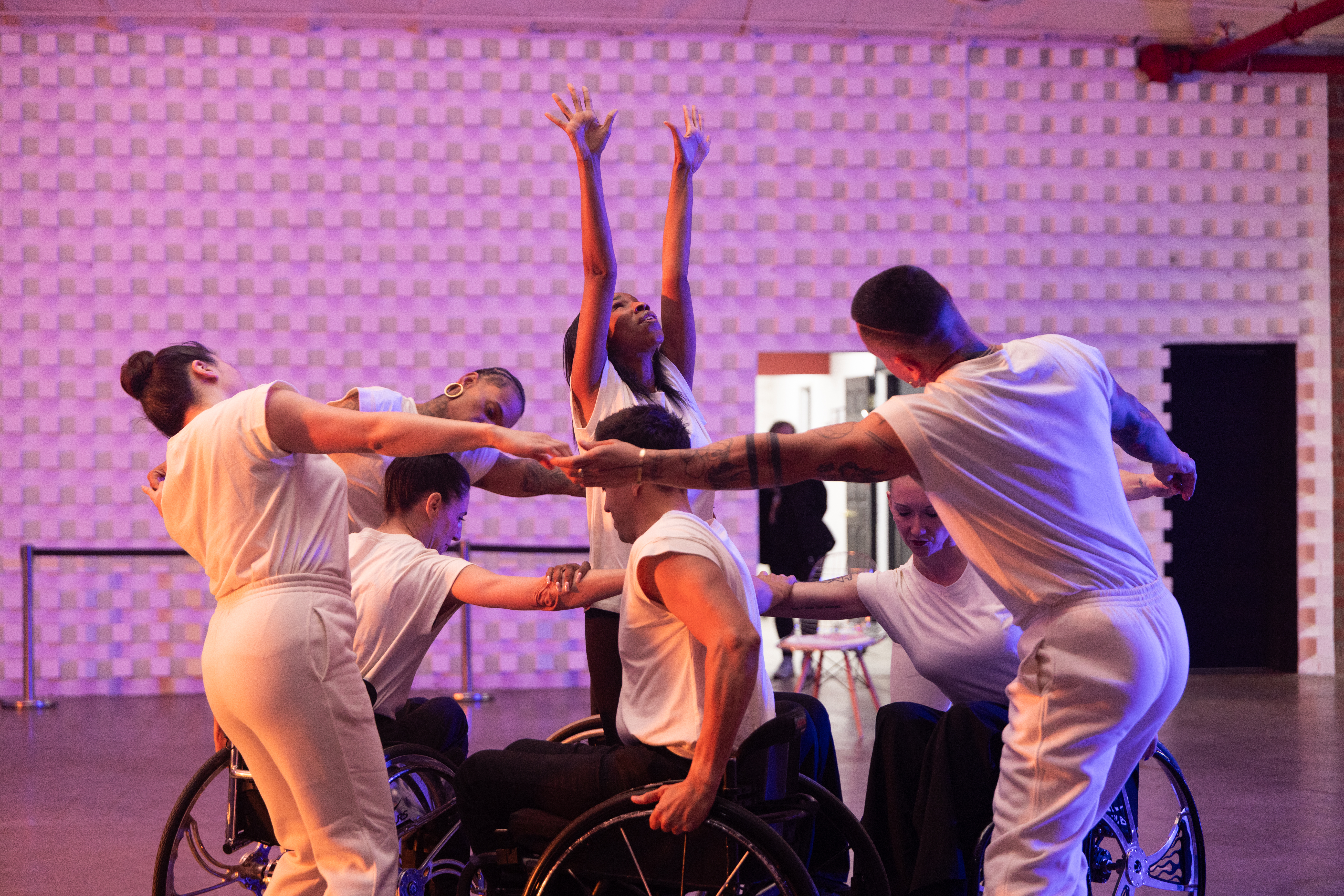
I’m the founder of Infinite Flow Dance, a disability-led professional dance company based in Los Angeles with a mission to reimagine possibilities one dance at a time. I’m disabled myself. I’m a spinal stroke survivor and also a late-diagnosed autistic. It was during college that I had a spinal stroke that initially paralyzed me from the neck down, which eventually led to creating Infinite Flow.
I had lived in this duality where I knew in my gut that dance is a universal language, yet society and the dance industry were making dance accessible to only a few. So, I’ve been on this journey of redefining what dance and a dancing body are; using dance as a catalyst to send a broader message to the world that we are all unique and beauty can be defined in infinite ways.

Marisa Hamamoto (in red) directing Boyband dancers on set – Photo by Colin Oh
I would love to learn more about your work, but first of all, what was your upbringing like?
I was born in Japan between a third-generation Japanese American father from Hawaii and a Japanese mother who is a native of Japan. I would say my mom and my dad grew up in very different worlds, so I identify as both Japanese and fourth-generation Japanese American. I was 2 years old when my family immigrated back to the States. I grew up mostly in Irvine during the 80s and 90s, when Irvine was still a predominantly white city. Growing up in a white neighborhood, I was often picked on for looking different. I learned quickly that our differences can divide us. My happy place was dance after school, where, even though I was the only girl of color, something about moving my body to music–I felt like I belonged. At an early age, I learned the power of art can unite us, connect us, and transcend differences.
My mother grew up playing piano and majored in music education in college in Japan. She would occasionally teach kids private lessons in piano. She knew the significance of giving children music and arts education. I took some piano classes, but honestly, I didn’t really like practicing at that time. Next to the Yamaha Music School was a dance studio, and you could hear piano music playing. I said, “Mom, I want to move to piano. I don’t want to play piano.” So, she let me take ballet class once a week. That was the beginning of dance. My father dabbled in guitar in his 20s for fun, but he really didn’t have much of an arts background. He kind of intuitively knew that traditional education was limiting, and even though my family didn’t have much, if I wanted to dance, they did everything they could to provide that opportunity.
My mom is also a painter; she started painting mostly tole paintings, this specific style of acrylic art that she pursued as a hobby. I grew up seeing her paint all the time, and it’s interesting because now I started painting. A very different type of art than she does, but I definitely have texted my mom several times saying, “Hey, what am I supposed to get for this and for that?” And she usually sends me the exact solution that I need. I think especially because we’re all getting older, I do feel this calling. Painting is bringing my mom and me closer in a very different way. She still paints, and she’s done a couple of little tiny art exhibitions in Tokyo where she’s spending half the time.
During my teenage years, I aspired to be a professional ballerina. That came from a performance of the New York City Ballet at the Segerstrom Center in Orange County. It only took 30 minutes for me to go, “That’s what I want to do.” At that time, I didn’t know I was looking at a stage of hundreds of ballerinas where no one was like me. I remember seeing one black ballerina in the quarter ballet; I think that was Aesha Ash. “I can be that one Asian ballerina,” was kind of what went through my head. I didn’t know that I was getting into a territory of dance that was not fit for my body and talents whatsoever.
In ballet, there’s this expected box that was set in stone, and I was so far from it. But I kept on pushing through and auditioned for scholarships at different schools, trying to pursue this ballerina career. I didn’t know that constantly being told that my body wasn’t right for dance was going to be emotionally damaging for my life. At the same time, a part of me was like, “Am I really not made for this, or is there a facade of ballet that’s been created?” I do appreciate having learned ballet; there are a lot of good things about ballet technique. There are some postural exercise benefits–if it’s done safely with a teacher who understands anatomy.
I went to an elite ballet school in junior high school. Every day was full of trauma from not fitting the ballerina aesthetic. I acquired some bad eating habits and was on the verge of different eating disorders. How I perceived my body was very negative. I think it took into my 30s to learn to let go of that. Today, I have a very healthy mindset over my body. I always feel like we can continue to listen to our bodies and develop better, healthier habits. Even with dance, I thought I would be done now that I’m in my early 40s, but I feel better now than I did 10 years ago.
When I was a senior in high school, I went to a performing arts school called the Idyllwild Arts Academy. I only spent my senior year there, but it was probably the best year of my K-12 experience. Idyllwild was where diversity and inclusion were actually valued. About half the school was international students from everywhere. I did get a full scholarship to cover my tuition. Otherwise, there’s no way we would have been able to afford it. But this was the first place where I felt a sense of belonging at school, where I was also exposed to LGBTQ+, and this was 26 years ago. The dance department wasn’t big; I think there were 40 students altogether between grades 7-12 at that time. Very diverse, too–diverse bodies, diverse goals. Not everybody wanted to be a dancer. Some wanted to be choreographers, producers; it was a very mixed bag of dance students. So, I felt very accepted within the dance department.
At the end of the year, the senior dance students had an opportunity to choreograph a six-minute work. This was my first time choreographing something, and there were 14 of us. I was excited not only to choreograph, but also to be part of my friends’ and peers’ works. But when casting was announced, no one had selected me to be part of their work. That was really, really hurtful. The pain that came from that was so much bigger than being rejected by a dance teacher or an outside choreographer. It was my peers. But when I looked at the notice again, seven other students were missing from the cast. On a whim, I took a pencil out of my backpack and wrote down all seven names into my own cast. The dance department chair and co-chair were like, “Marisa solved our problem!” They were also trying to figure out what to do with these students who were missing from the cast.
And we had a good show. I remember everyone recognizing the act of leadership that I took. I was named Dance Major of the Year at graduation, but the bigger win was that a policy was placed in the dance department, ensuring that all students participate in the student choreography dance concert. It’s been almost 26 years since my graduation, and that policy is still there. So my small action of taking out a pencil and writing down seven names into this casting notice led to lasting change in the department. That eventually planted a seed for Infinite Flow–a lot of things where it’s just that one small action, or one decision, or one connection led to this. The question I always ask anybody asking for advice is, “Hey, what’s one thing you can do right now that can propel you forward?” or “What’s one thing you can do right now that will make you feel better?”
So, you’ve been a change-maker since you were a high school student.
I guess, in retrospect. At that time, I didn’t connect to being a change-maker. I didn’t even know what “change-maker” was until probably the last few years. But if I were to trace back my past, in addition to having a stroke that paralyzed me when I was 24 in college, writing seven names down on a casting note really carried me on to who I am today.
What drew you to LAPP’s ACCELERATOR program? How has it been going for you?
I’ve been on LAPP’s email list for some time, and I felt that the way LAPP was presenting itself was a hub for artists in LA. I found the language to be very artist-facing and artist-friendly. I’m an artist that kind of straddles between performing arts, commercial arts, and entertainment. I saw that this collective was leaning a little more towards non-commercial arts, but regardless, I resonate with being an artist. Then I saw the notice to submit for the LAPP ACCELERATOR at a time last year where I was doing a lot of soul-searching and reflection. Part of that has been getting really clear about Marisa as an artist. I’ve been a spokesperson for Infinite Flow, but Infinite Flow is something I created–so, what is Marisa?
Not that I have a clear answer at the moment, but I felt like it’d be cool to be amongst other artists to get some inspiration. I was actually surprised I was accepted because I felt like my background was a little more commercial than most. So far it’s been really great to be amongst artists who put their art at the center. Everyone has a deep connection to their craft. And some have forms of art that are kind of very niche, and it’s cool.
In terms of the business side and sustainability as an artist, it’s both ways. You go and apply for applications, but you also have to create and allow things to come to you. It’s this cycle. It’s been great reflecting on, for example, an Artist Statement, which I haven’t really reflected on before. Even writing an Artist Bio took me a moment to go, ‘what the heck is that?’ I have more clarity over grant writing. At first I was really uncomfortable with having to share a spreadsheet of things that you’ve submitted to and results. But I noticed this is part of the process and there’s no judgment here. Sometimes you’re going to win and sometimes not, but you’re going to learn every single time you submit something, and the rejections feel less hurtful.
The leaders within LAPP have been great – whether it’s Gina [Young], Scarlett [Kim], [former Director of Creative Resourcing] Marsian [De Lellis], or Miranda [Wright], I was also reminded how we don’t need to do this work alone. Gina, Marsian, and Scarlett are artists themselves. They’re applying for grants and continuing to build their portfolio, yet they’re also mentors. It’s inspired me to start building my own mentorship program. Yes, I started to feel this calling to start painting last year, from multiple angles, but being amongst the LAPP artists made me realize I don’t have to be one thing. Learning about Chohi’s work has been interesting because she’s an opera singer, and then I go to her website and learn about what she’s doing. I’m going, “Oh my gosh, I didn’t even know that other worlds of opera existed.” I feel like a lot of the artists within LAPP fall into this unclassified category of art, and that’s been great to be part of.
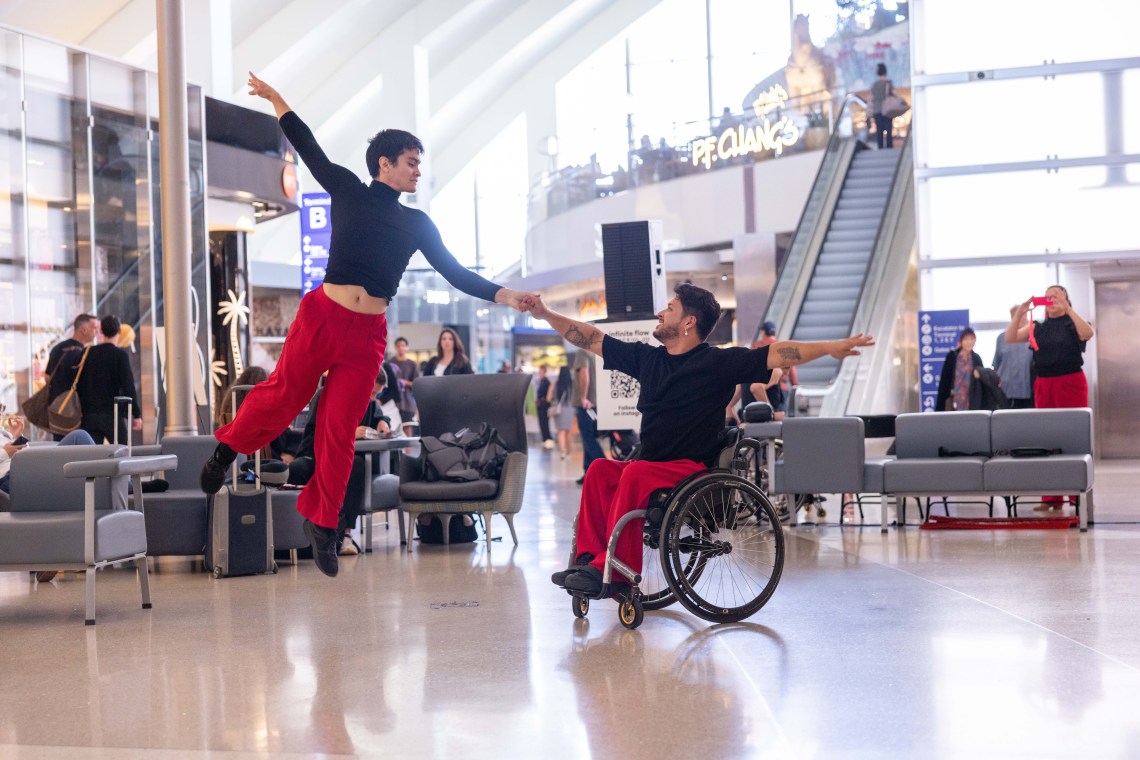
Infinite Flow Dance performs at Los Angeles International Airport
I’m so happy to hear that, and we’re so lucky to have you in our space. What has ‘Artist Marisa’ been working on recently that you would want to share?
Infinite Flow is 10 years old, and we’re celebrating our 10th anniversary in multiple ways. We’re going through a reinvention and rebranding process. It’s an evolution that’s going to happen throughout the year, and I have some milestones I’ve set for this. Some of them are very clear, and some of them are where I understand the feeling and direction, but don’t have the exact clarity of what tangible thing it is. So, that’s kind of my focus as an artist: the reinvention of Infinite Flow this year.
Today, I’m taking a hip-hop class. Not because I’m a hip-hop dancer, but I’m just trying to get more comfortable dancing solo. I’ve built a career mostly as a partner dancer. Salsa, ballroom, and even contemporary dance–it’s a lot of contact improv. I didn’t grow up with contact work, but it’s what I’ve specialized in since my stroke. I still battle a little bit of this lack of confidence and insecurity I had when I was a ballerina; as an adult, it just shows up differently. So this year, one of my goals is to feel better dancing alone, freestyling alone. It might not even lead to any work, but I want to feel better connected to myself. And at Infinite Flow, I play dual hats of being the leader, but sometimes my artists who have more experience than I in some areas of dance become my teachers and mentors.
At times, there’s a part of me that feels like, should I even be performing? Should I just be directing? But then I’m like, there’s more in me to continue as a performer in this company for the time being. As an individual performing artist, there’s a part of me that craves to be in shows and projects outside of my dance company. So, I’m thinking through how I want to go about that.
Other than that, I feel this calling to go into fine and visual arts. I have a couple of projects leaning in that direction for Infinite Flow that are launching soon. The painting, I think, intersects with that, too. I think since getting into visual arts, it’s a different part of my brain that’s being used. I’m also realizing how much I really enjoy creating visual things. That’s something that, since a kid, came really intuitively for me. Once I understood a technique, I was always able to build and expand on it. And now, thank you to YouTube, Instagram, and all this social media–the entry into these mediums has become easier. You don’t have to go to art class physically; you can take an art class virtually, join groups virtually. So, that’s been fun.
I think business growth and sustainability are a huge theme in my sphere. There’s a reason why we call it show business. Most artists struggle with the business part. And thank you, LAPP, for existing because I think it helps artists kind of ease into the business aspect.
To end, what’s one thing that makes you really happy in your life right now?
One thing? Roller skating.

Marisa Hamamoto (she/her) is the first professional dancer named to People Magazine’s “Women Changing the World.” A leading authority on mental wellness, disability inclusion, Asian American experience, building a culture of belonging, and changemaking, Marisa is a LinkedIn Top Voice, and has been featured on Good Morning America, NBC Today, Forbes, Fast Company, amongst other media outlets. As a sought-after international speaker, performing artist, and creative director, Marisa has been a speaker at the United Nations, shared the stage with Tim Cook at Apple HQ’s Steve Jobs Theater, and her clients and partners include Google, Apple, Microsoft, Meta, Red Bull, Deloitte, adidas, PayPal, Farmers Insurance, Kaiser Permanente, among other forward-thinking brands. Marisa is a spinal stroke survivor, a late-diagnosed Autistic, a proud fourth-generation Japanese American, and a pandemic-born artistic roller skater. She is the founder of Infinite Flow Dance, an award-winning dance company and nonprofit that employs disabled and nondisabled dancers with diverse, intersectional identities, with a mission to advance disability inclusion, one dance at a time. Marisa is bilingual and bicultural. She completed her BA & MA from Keio University, Tokyo, and is an Honorary Member of the International Association for Dance Medicine and Science. Most recently, she was a Finalist for Best Film for the Easterseals Disability Film Challenge 2025 – Film: “Killed It.”