By Jazz Zhu
ACCELERATOR is Los Angeles Performance Practice’s flagship artist development program—a nine-month intensive that empowers multidisciplinary artists to build sustainable, visionary, and self-determined creative careers. A thoughtfully-selected cohort of twelve Los Angeles-based artists meets bimonthly to engage in professional development workshops, in-depth mentorship, and peer accountability to design a resilient creative life. By the end of the program, participants will have artist statements that celebrate their whole selves, a personalized strategy for resourcing their practice, and a sustainable approach to producing the work they’re passionate about.
ACCELERATOR cohort member Scottie Harvey (she/her) is a writer, performer, and animator from Los Angeles whose work brings cartoon logic into alternative mediums: translating gravity-defying gags for the theatre stage or writing emotionally grounded character studies into otherwise absurd contexts. On a sunny afternoon, Scottie sat down to talk about moving between animation, theatre, and writing, how imagination connects those worlds, and the role of community in her practice.

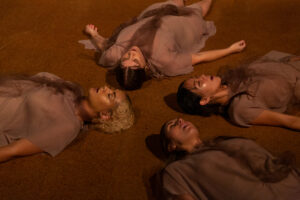
Photo from “A Live-Action Adaptation of an Episode of ‘Tom & Jerry'” taken by Reza Mirjalili
To start, for those who don’t know you yet, how do you introduce yourself?
I’m a writer and an animator. My background is in animation, and most of my writing lives at the intersection of animation and lived experience.
How did that begin? What’s your origin story with animation and writing?
When I was little, I loved doing funny voices. I realized animation was a way to give those voices bodies, and it became a backdoor into making my own work. Later, in graduate school, I saw a play for the first time and thought, oh, this is related. Animation and theatre both rely on imagination. In a good play, you can believe an empty chair is someone’s mother. Animation does the same thing, except the mom is literally a chair with eyelashes.
Do you remember the first play that really stuck with you?
Strangely, yes, and it was terrible. It was a community theatre play about Martians in an intergalactic talent show. They were judged by how loudly the audience clapped, but the Martians had tendrils for hands and couldn’t clap. It completely rewired my brain. The things that are truly bad often end up shaping what I love most. Later, seeing higher-production work at places like Playwrights Horizons and New York Theatre Workshop, that high-low mix fused together for me.

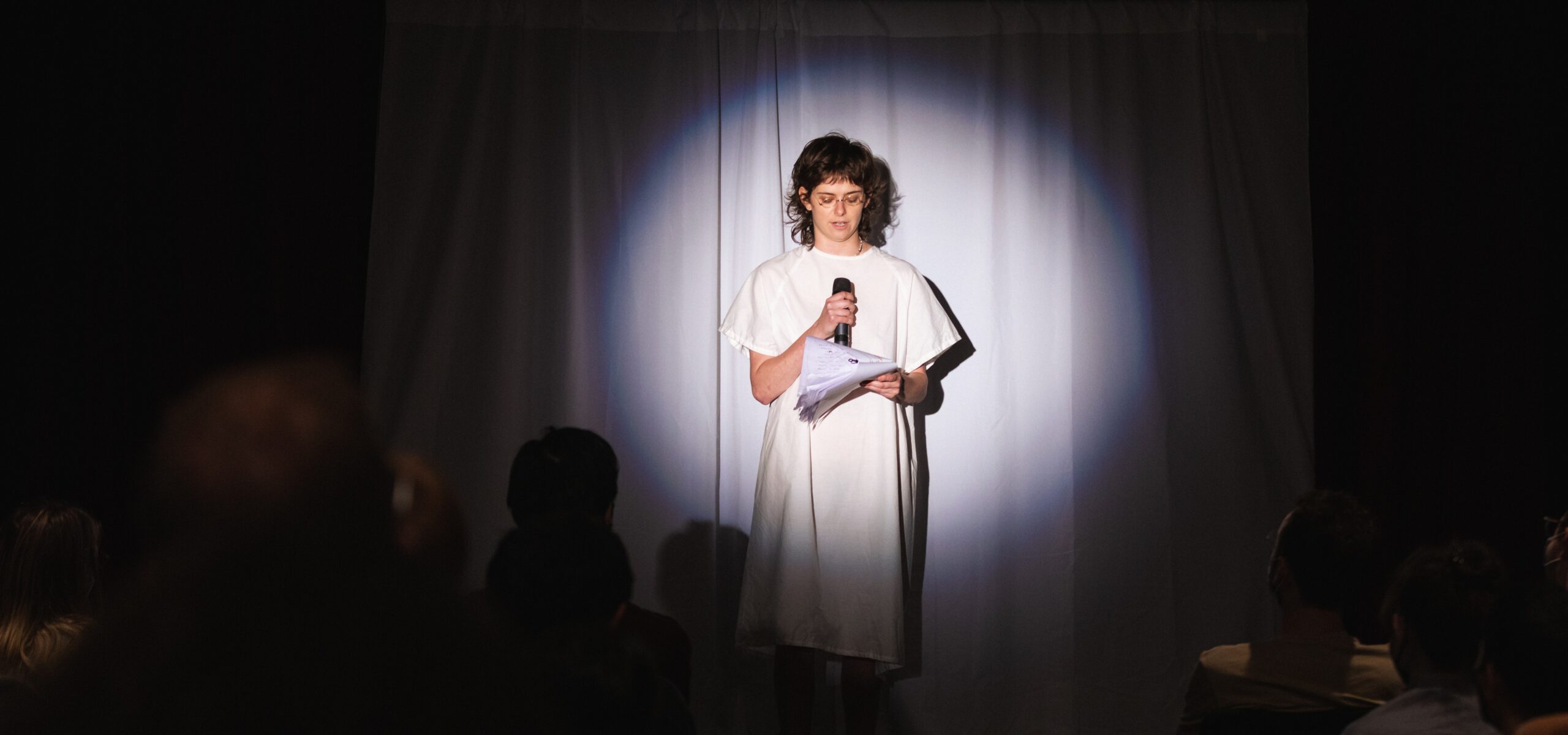
Photo from “A Live-Action Adaptation of an Episode of ‘Tom & Jerry'” taken by Reza Mirjalili
Let’s talk about your work. You’ve made theatre, animation, and now you’re writing a novel.
When I lived in New York, I was writing primarily for theatre. In 2023, I made A Live Action Reenactment of an Episode of Tom & Jerry, a real-time stage translation of a cartoon episode performed as literally as possible. The piece explored where physical reality breaks cartoon logic. We made it with no money, our director was in grad school, so rehearsal space cost about a dollar an hour. Rewriting the show in the room and experiencing the actual limitations of gravity, which doesn’t exist in cartoons or only exists for the sake of subversion, felt transformative.
I grew up in LA, and since moving back in 2023, I’ve been working on a play called Holegazers. It’s about a gay pornstar who discovers his image is being used in workplace accident-prevention animations. I play him onstage, which creates immediate dissonance, since I’m a cis woman playing a gay male porn star. The play looks at online intimacy and how bodies get recontextualized in working-class settings.
I also just finished the first draft of my novel, Rat in a Man-Shaped Hole. Writing it was incredibly freeing. Theatre always requires thinking about producing. The novel let me work without that burden. I spent a year just writing alone, which was a gift.
Do you use the same muscles across mediums, or does writing feel different from animation and theatre?
They’re definitely different. Theatre is inherently collaborative. I’m always thinking about who I want in the room. I’m the person who texts someone at 1 a.m. with an idea I just had. Writing the novel put me in a more intimate space with language. No bodies, no logistics, just words. It’s lonely, but I like that too. With theatre, I’m always thinking about the audience. With the novel, I’m just asking, how can I make myself laugh?

Painting photographed by Erika Keck
How would you describe your animation style, if there is one?
I work cheaply, graphite, notecards, Bic pens. Lowering the barrier helps me stop overthinking. I like writing something in two minutes and animating it for a month. Attention transforms meaning. I especially like animating writing I don’t fully understand yet. That’s usually where the piece reveals itself.
What does your writing and editing process look like?
Notes app, mostly. I wrote an entire play while walking my dog. It reminds you that writing can happen anywhere. Editing means printing everything out, using too many pens, and trying to make sense of it all.
Do you feel supported as an artist living in LA?
Very much so. I co-host Animation Clubhouse with my friend Sam Lane. We’ve known each other since we were twelve, and it’s become a real community for animators who spend all day alone and just want to talk about YouTube videos. For writing, Beth Pickens’ Parakeet program changed my life. It’s a writing accountability group, and I’ve made lifelong friends there. To quote Jill from Real Housewives of New York, I run with a fabulous circle of people.
How does having lived in both New York and LA shape your life now?
The stakes feel lower. I don’t feel constantly measured. Some days I don’t leave the house. I listen to bad music loudly in my car because no one can hear me. I stopped worrying so much about how I’m perceived. Feeling less watched has been everything.
Who are your biggest artistic influences?
The B-52s, especially Cindy Wilson. “Give Me Back My Man” always re-centers me. I love lyrics that are emotionally sincere and totally strange. Erin Markey is my favorite playwright and one of my closest friends. Sally Cruikshank is my favorite animator. Quasi at the Quackadero changed my life. I own a terrible animation cel from it and cherish it.
How is the ACCELERATOR going for you so far, and what are you hoping to get out of it?
At first, I felt a little overwhelmed. There was a lot of practical information, and my instinct with that is usually to run. But now I’m excited. I’m starting to synthesize things, especially around applying for programs and grants, and a lot of that has been immediately game changing.
I also love hearing other people talk about their experiences. I feel like the least experienced person in the group, which is actually the best place to be. Being a beginner in a room full of pros is a gift, and I’m excited to see what everyone makes and how we can support each other.
Last question: what’s your favorite animated film?
Sünnipäev by Janno Põldma. It’s a short Estonian film about a kid’s birthday. Funny, dark, perfectly paced. Once you see its colors, they’ll become your favorite colors. Everyone should watch it.
Scottie Harvey (she/her) is a writer, performer, and animator from Los Angeles. She received her BFA & MFA from NYU’s Tisch School of the Arts, where she found animation’s unlikely twin in theatre. Dramatic work has been featured at Dynasty Handbag’s Weirdo Night (2025), and writing will be included in Michelle Tea’s Clown Anthology (2026). Her play “A Live-Action Adaptation of an Episode of Tom & Jerry” ran at Pageant (Brooklyn, 2023) and was read at Theatre Rhinoceros (San Francisco, 2024). Older plays have premiered at Ars Nova’s ANTFEST and received the Kennedy Center American College Theatre Festival’s Paula Vogel Award. Her animated work has been featured by musician Julien Baker and screened at many festivals. Scottie runs the performance space “Van Noord Van Noord,” which has hosted resident artists such as Erin Markey, Carl Holder, and Sacha Vega. She co-hosts the monthly “Animation Clubhouse” with Sam Lane.