By Isabel Ngo
This article originally appears in the California Arts Council Individual Artist Fellowship Catalog, produced by Los Angeles Performance Practice in partnership with the California Arts Council. This activity is supported in part by the California Arts Council, a state agency. Learn more at www.arts.ca.gov
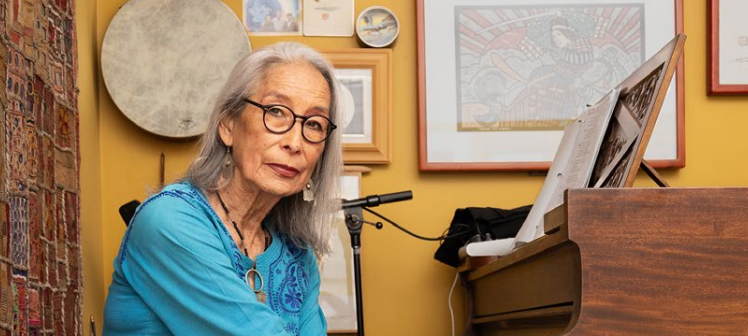
Dancer, singer, songwriter, and elder Nobuko Miyamoto describes herself as a community artist, whose art is intertwined with her decades of activism and organizing.
Alongside the rise of the civil rights, Black Power, and anti-war movements of the 1960s and early ’70s, Nobuko Miyamoto found both her role in the struggle and her artistic voice, creating music that invigorated the Asian American movement. She, Chris Iijima, and William “Charlie” Chin formed a folk music group, touring the country with protest songs of racial solidarity within the liberation struggles of the era. In 1973 they recorded their songs in A Grain of Sand, which is considered the first album of Asian American music.
“I met Chris Iijima, who was an activist,” Nobuko recalls, “and we stumbled into writing a song. When we performed that song in front of an Asian audience, it was like, ‘Oh my God.’ It was like this magic moment. We never had this before. This is our song—this is what it sounds like, this is what it looks like. … And that’s how I began my second life as an artist, to create music, theater, and dance that expressed who we were as Asian Americans.”
Now in her eighties, Nobuko continues sharing her work and legacy. Earlier this year at the VC Film Fest in Los Angeles, the Japanese American National Museum presented the world premiere of Nobuko Miyamoto: A Song in Movement, a documentary which will also be featured this fall in the PBS series Artbound. In 2021 the Smithsonian released her most recent album 120,000 Stories, collecting Nobuko’s original recordings from the ’70s, as well as her new music uplifting Asian American issues, Black lives, and environmentalism. The title refers to the mass incarceration of more than 120,000 people of Japanese ancestry in US concentration camps during World War II. Nobuko also published her memoir in 2021, entitled Not Yo’ Butterfly: My Long Song of Relocation, Race, Love, and Revolution, which her mentor, the late activist Grace Lee Boggs, had encouraged her to write.
“I knew that my life had been connected to a very distinct and important historic movement, not only for the Japanese American community but for people of color in general,” Nobuko says, recalling her process of writing the memoir and her desire to spread awareness of the Asian American movement. “And my engagement as an artist in that was really important to tell. Because artists make work which are archives—paintings and music and theater etc. They’re all archives.”
Nobuko’s story is a transformative one. She was born in 1939 as a third-generation Japanese American, and grew up in the internment camps—specifically the Santa Anita detention center, which was one of the largest camps where Japanese Americans were forcibly removed. After her family was released, she pursued her art education, as her father was the one who exposed her to music and Nobuko had been drawn to dance from the young age of four. She went on to perform in films and musicals in the ’50s and ’60s, including The King and I and West Side Story and Flower Drum Song on Broadway. This is when she recognized something was missing.
“When I was a young person, I never heard a song that sang my story, or sang what I felt,” she says. “There was no place to find a real expression of who we were either at that time in the 1950s, where other people were writing stories about us. … it was a mythology that was created outside of our own expression, and it satisfied white people’s needs.”
This is what led to Nobuko’s political education and activation. Her vocal instructor Dini Clarke shared his own experience of racial discrimination as a Black man and taught her about the storytelling mastery of Black women singers Billie Holiday, Lena Horne, Carmen McCrae, and Nina Simone. In 1968 she worked on a film about the Black Panthers and continued her involvement in social activism in New York, meeting Yuri Kochiyama as well as other activists like Chris IIjima through Asian Americans for Action. Following their powerful tour of protest music across the US, Nobuko Miyamoto returned to Los Angeles, where she found her community base at Senshin Buddhist Temple in South Central with the help of Rev. Mas Kodani and started teaching dance classes, rehearsing for performances, and connecting more deeply with Japanese culture.
In 1978 Nobuko founded Great Leap in Los Angeles, which expanded from an Asian American performance group to a multicultural arts organization and is still active today. In addition to its live performances, educational music videos, and training programs for artists, Great Leap hosts the FandangObon eco-festival, an annual celebration that has gathered together Japanese, Mexican, and Black communities and other local groups in LA through traditional music and dance.
“When you make music together, when you dance together, and you have ideas—something clicks in, where you are connected in a very deeper way than having a conversation without that.”
Nobuko Miyamoto started FandangObon with musicians and activists Quetzal Flores and Martha Gonzalez in 2012 when they discovered similarities between the Japanese Buddhist ancestor remembrance rituals of obon and the traditions of son jarocho, a musical tradition that was influenced by Indigenous, African, and Spanish communities in Veracruz, Mexico.
“We had a cultural link,” Nobuko explains. “They were involved with fandango son jarocho, this form of circle dance, circle practice, where they had a platform in the middle, and the guitar players would play around the platform, and then dancers would get on the platform and step out rhythms. It was very participatory. And I had been working with Obon… we make a circle too. We have a platform in the middle that musicians usually stand on, and then people dance around that platform. And so when I saw that, I went, ‘That looks very familiar to me; what would happen if we combine?’ And that’s how we got started.”
Together, they determined that the FandangObon festival would be a conversation between cultures, highlighting each culture’s unique practices while drawing a link to their shared environmental values and the communal power of music. Through the years, they have collaborated with the Nigerian Talking Drum Ensemble and Muslim artists and performers to incorporate West African dance and Sufi traditions in the festival as well.
Nobuko describes how these cultures’ long-standing traditions can teach us how to treat the earth and share its resources. “They weren’t in such a hurry to make big bucks, to destroy the environment—they tried to live within the environment. So earlier cultures were really much more careful about the environment. And so we wanted to dig into those traditions to show people, going backwards, looking backwards could actually help us move forward.”
Here’s to learning from Nobuko Miyamoto’s inspiring story and moving forward with purpose. “I’ve just been going for all these years… but the work and the collaborations and the range of communities, I think, has been important for people to see,” she says. “And for artists, for younger artists to know and figure out: how do we serve this changing world? How do we use art to really move us forward and move us together, and keep us from being torn apart in this very difficult period of time?”

Photo by Argel Rojo