By Isabel Ngo
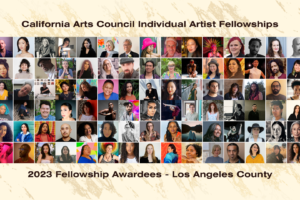
This article originally appears in the California Arts Council Individual Artist Fellowship Catalog, produced by Los Angeles Performance Practice in partnership with the California Arts Council. This activity is supported in part by the California Arts Council, a state agency. Learn more at www.arts.ca.gov
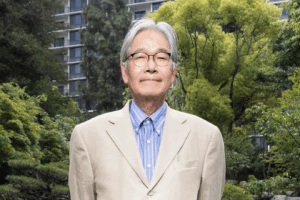
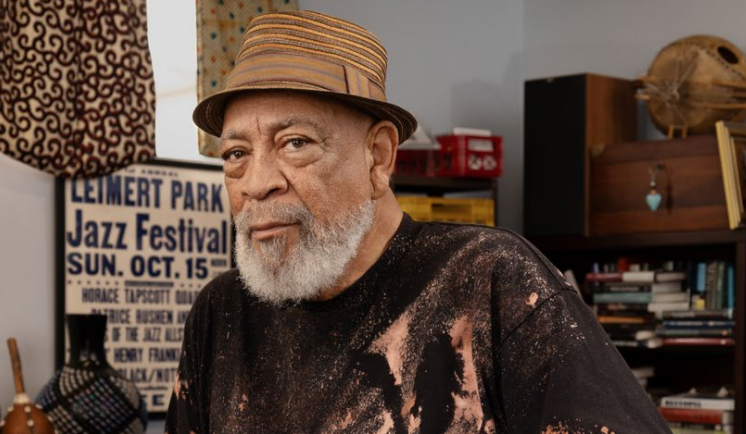
Creativity and history runs through the blood of revered poet Kamau Daáood.
Honored with numerous accolades, Kamau has been writing poetry, performing, teaching, and lifting up his hometown of South Central for over fifty years. He’s published multiple books of poetry including The Language of Saxophones (2005), has performed his work internationally, and has been featured in several documentaries.
Dubbed a “word musician” of his community, Kamau is known for his powerful live readings, which are often accompanied by jazz musicians playing alongside his poems’ vivid imagery and chanted words of invocation. Onstage, he explains, “the page just becomes the instrument. So I read the words, but I try to transcend … I just try to let go.”
One of Kamau’s first public readings was also his initiation into the Pan Afrikan Peoples Arkestra, the South LA ensemble that has been preserving and presenting music from Black composers and musicians since 1961, and that Kamau is still a member of today. Known to many as simply the Ark—so aptly named for a vessel that holds sacred things—the multigenerational band has always been dedicated to community, social consciousness, the arts, and African culture.
He was attending a festival in South Park where the ensemble was playing one day, when community member Ted Jones noticed eighteen-year-old Kamau had his poetry with him and told Horace Tapscott—the legendary jazz pianist, composer, and founder of the Ark. “The next thing I know,” Kamau says, “the Ark was performing on stage. They were playing a tune called ‘Equinox’ by John Coltrane, and I’m on stage with a fourteen-piece band behind me, reading my poetry. And then from that point on, I considered myself drafted into the Ark.”
As we continue our conversation, I’m struck by how Kamau’s life and career are intertwined with the arts movements of Los Angeles. Born and raised in South LA, Kamau Daáood started writing in high school before connecting with other Black poets in the Watts Writers Workshop as a teenager. There, “the criticism that you got from people was really sincere and really intense,” he recalls. “If you came with something that was weak or you didn’t put a lot of work in it, they would let you know where it was, you know. And when you hit the mark and really did your job, they would let you know that too. And that was a very encouraging environment.”
He was influenced by the older, founding members of the workshop—including legends Ojenke, Eric Priestley, K. Curtis Lyle, Quincy Troupe, Wanda Coleman, and Jayne Cortez of the Los Angeles poetry scene in the ’60s and ’70s. Kamau also nurtured his craft under the mentorship of many other artists in LA, including Horace Tapscott; John Outterbridge, the former director of the Watts Towers Art Center; and Billy Higgins, one of the most recorded drummers in jazz history. Though these three greats have since passed and are honored as community ancestors, Kamau feels blessed to call them mentors.
Mentorship is tied to teaching by example, according to Kamau, as much wisdom is passed down just by “being around great people, and seeing how they navigate the world, how they are with other people, how they approach their art form, how they organize.” He takes this concept to heart in his interactions with young people as well, where it’s important to “just be true in front of them, to tell the truth and tell your stories,” he says.
In addition to his roots in South LA, Kamau is inspired by griot traditions from West Africa, where storytellers called griots, or djelis, are responsible for collecting the histories of their villages. “I’m talking about everything from the actual history to the emotional history,” Kamau explains. When griots pass down these stories through oral tradition, epic poetry, and music, “they refresh memory. They accent important issues. They teach us, they show us ourselves.”
Kamau Daáood’s commitment to this storytelling and community building tradition is clear. In 1989, he co-founded the World Stage Performance Gallery in Leimert Park with his mentor and master drummer Billy Higgins. It began as an informal collective and jam session space inspired by smaller “storefront” arts organizations Kamau grew up with, especially gathering spaces of the Black Arts Movement of the ’60s and ’70s. But soon, as they presented concerts and offered writing and vocal workshops, many people became drawn to The World Stage. Jazz musicians Herbie Hancock and Charles Lloyd visited the Stage, among many other icons. Kamau even recalls Nina Simone sitting in the audience one day. Today, the World Stage has grown into an organization that continues to inspire and gather together Black musicians, writers, and artists with its concert series, weekly workshops, and other programs.
Kamau’s work as co-founder and former artistic director of the World Stage also led him to realize how community organizing can be an art form in itself. “Even if I’m not writing or performing, I’m in community and interacting with people, and I can’t help but be who I am and what I am. And my ideas and my feelings are constantly being put on the table of the world.” With this mindset, Kamau envisions that anywhere a creative is can become a space for art. “It can be in what you say, it can be the way that you approach things. It can be in a poem, it can be set to music, it can be put to dance. It could be a performance for one person, it could be a performance for a thousand people.”
As a respected community arts activist, Kamau Daáood has also witnessed the gentrification of South LA through the decades. It’s an issue he highlights as important for Leimert Park, “the cultural hub of Black Los Angeles,” a place built by the local community and where musicians, writers, artists have thrived. “If we lost that, it would be a big blow to Los Angeles.” When corporations and entities with capital priorities have come into Leimert, they often buy up properties with ideas of potential profits, he explains, and sometimes from young people who are not aware of the value of their parents’ or relatives’ properties. As a result, those who have lived in Leimert Park for a long period of time—and who have been long invested in their communities—are often pushed aside.
Kamau believes art and culture also plays a role in calling attention to gentrification, racism, and other social issues. In 2023, the California Arts Council recognized Kamau Daáood’s artistic and community work with a Legacy Artist Fellowship—an award that, in his eyes, has granted him the valuable gift of time. He explains how living as an artist has required him to take on side businesses and other projects to make ends meet in the past. Things have always worked out for Kamau and his family, but he’s been in situations where he was “right on the edge.” “I have so much hustle in me, from the way I’ve had to live,” he shares. “A big part of this process is just me establishing another relationship with my time. It’s okay to rest when I want to rest. It’s okay to just zone out and work on something, just spend time and be engaged in something. It’s okay, you know, to have time to read books and stuff like that. So I’m thankful for this time and I’m confident that some work will come from it.”
Kamau is currently working on a host of projects, from organizing a comprehensive archive of his work, to writing a memoir, to publishing and recording new poetry, and possibly being part of another documentary film. And while many artists of his experience often focus on retrospectives, Kamau assures us: “Mature artists are clearer about what they see going forward than ever.”

Photo by Argel Rojo