By Isabel Ngo
This article originally appears in the California Arts Council Individual Artist Fellowship Catalog, produced by Los Angeles Performance Practice in partnership with the California Arts Council. This activity is supported in part by the California Arts Council, a state agency. Learn more at www.arts.ca.gov
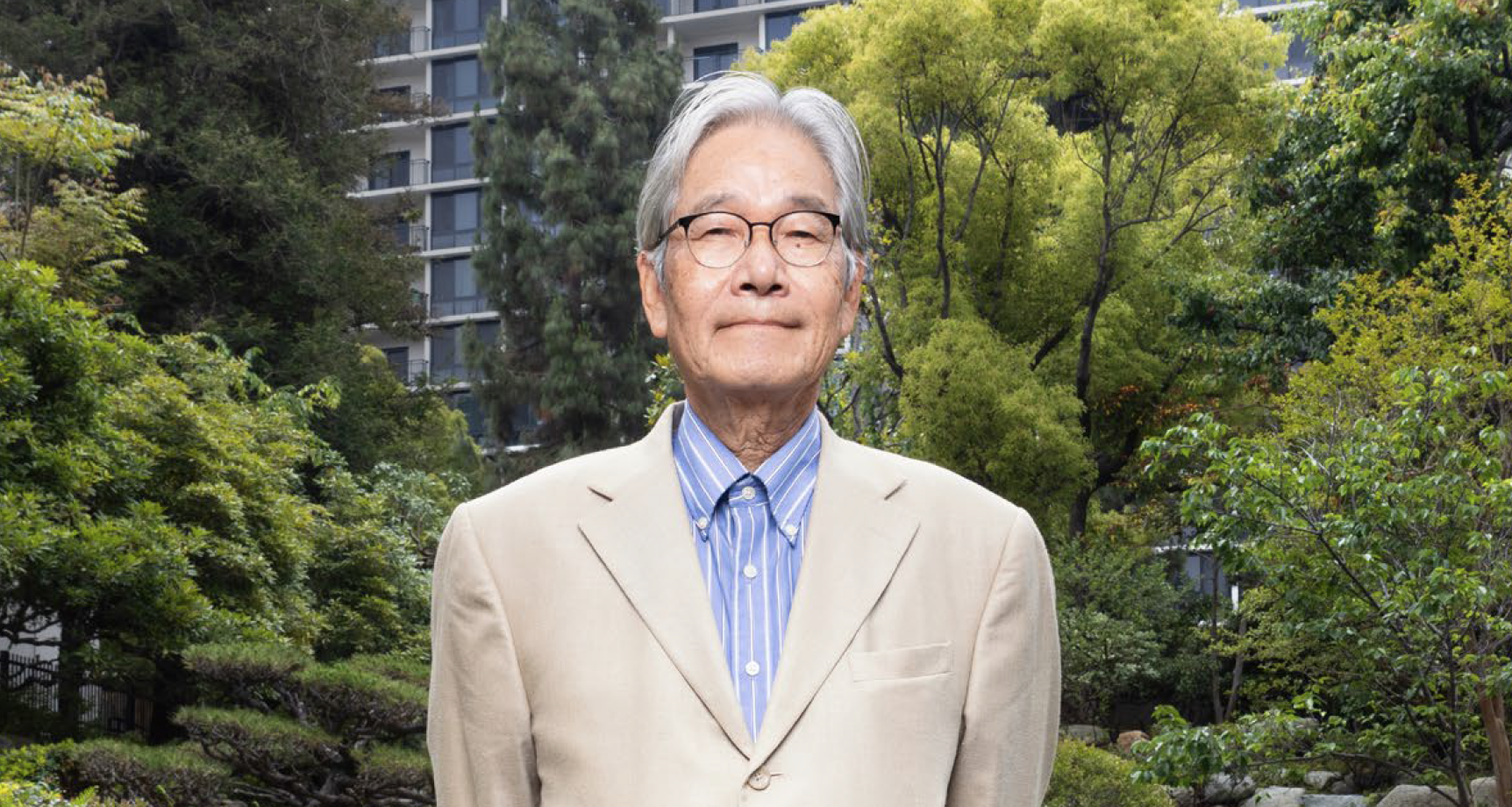
“To shoot yourself is to shoot your ego,” Hirokazu Kosaka says at the beginning of our conversation.
He sits in front of a backdrop of a large target, eighteen feet in diameter, at the Japanese American Cultural & Community Center (JCCC). This target is known as a “hazy target” in kyūdō, the Japanese art of archery, symbolizing a full moon with clouds and the blurring of boundaries. He painted the target thirty years ago here at the JCCC’s Aratani Theater during one of his performances. “It’s about myself, to shoot the self.”
A renowned performance artist and notable figure in Little Tokyo for over forty years, Hirokazu Kosaka was awarded a Legacy Artist Fellowship from the California Arts Council in 2023. As he recounts his life’s work—from his education at the prestigious Chouinard Art Institute and involvement in the conceptual art scene in the 1970s, to his formative years at the Buddhist monastery, to his ongoing programs at the JCCC—I am amazed by his legacy and impact on Los Angeles and the larger art world as a local elder and culture bearer.
He currently serves as JCCC’s Master Artist in Residence, though he has been advocating for Japanese culture and art there since 1983. Recent years have also marked many anniversaries directly related to his community involvement in Little Tokyo. Koyasan Buddhist Temple, where Hirokazu served as a minister, celebrated its 110th anniversary in October 2023. And earlier this year, Los Angeles Kyūdō Kai, the Japanese archery dojo that he has been teaching and leading for decades, marked their 108th anniversary.
Central to his artistic practice is a concept he has termed “On the Verandah,” which explores the rituals and infinite possibilities of in-between spaces. “The beauty of the veranda is profound, and it’s part of my life,” Hirokazu explains. “It is a space in architecture that is either outside or inside. It is an inbetween space. It’s not yes or no, it can be maybe. It’s not black, it’s not white, infinite shades of gray. It is a place, space, where man meets nature. And also it’s a buffer space. It is protection, a barricade between a space.”
This concept is key in his art as well as his teaching. At the JCCC, Hirokazu shares his cultural knowledge through traditional archery, tea ceremony, calligraphy, and flower arrangement workshops to students of all ages. “These are called the way, dō in Japanese—kyūdō, sadō, shodō, kadō. All those are a way of approach and observation.” He emphasizes the importance of emptying your mind, or “mindfulessness,” in all these practices.
Widely influenced by Buddhist spirituality, Zen archery, Noh and Kabuki theater, and the conceptual art movement, his work and performances have been exhibited throughout Los Angeles and internationally. One turning point for Hirokazu was Soleares (1973), in which he played the flamenco guitar with a razor blade inserted in his finger in Kyoto, his blood pouring onto the white floor of the gallery for an hour before he packed up his things and began a thousand-mile pilgrimage of walking in the forests and mountains of Shikoku Island. During this pilgrimage, Hirokazu Kosaka’s artistic spirit transformed into one of discipline. “It just overtook me,” he recounts, describing it as the moment when he decided to become a Buddhist monk. He was ordained as a Shingon Buddhist priest and lived at the island’s temple for three years, before moving back to Los Angeles, ministering at Koyasan Temple, and taking root at the Japanese American Cultural & Community Center.
He tells me about the creation of the new Kosaka Center for Art & Crafts—funded two years ago by a W.M. Keck Foundation grant. When you enter the Center, located on the fifth floor of the JCCC, you can see the sunlight coming in from the shoji screens and dark cabinets underneath the windows. As I learn more about his practice, Hirokazu Kosaka shares the fascinating story of these furnishings’ own cultural history.
Twenty-five years ago, he had invited paper craftsmen from Echizen, a city in Fukui Prefecture, Japan, that has been making traditional washi paper for the last 1,500 years. During their time in Los Angeles, the craftsmen visited not only the JCCC but also a number of art museums, including the Getty Center. It was there that one of them recognized their own Echizen paper at an exhibit of Rembrandt’s etchings from the 17th century, when the Dutch had an exclusive trading agreement with Japan. Artisans in Echizen continue to make washi paper today using traditional methods passed down through generations. “That paper is now sitting in my Kosaka Center, filtering the Los Angeles light,” Hirokazu explains.
The cabinets are imported as well, made with the wood of Hinoki cypress trees from Wakayama Prefecture. Seven years ago, Hirokazu himself traveled to the base of Mount Kōya-san, which is also where the Shingon sect of Japanese Buddhism is headquartered. There, he cut the trees on particular nights of the full moon with his relatives who are traditional carpenters from Wakayama. The cabinets were constructed and stained with Binchōtan charcoal and installed at the Kosaka Center in Little Tokyo. To Hirokazu, this beautiful space where he now hosts his workshops is also part of “On the Verandah,” as the paper screens become the in-between buffer, where sunlight filters in.
What’s next for seventy-six-year-old Hirokazu Kosaka? Look out for a major retrospective of his work “Hirokazu Kosaka: Art and Asymmetry” in fall 2025, presented by the JCCC in collaboration with curator Julie Lazar, through the support of The Andy Warhol Foundation. Alongside this upcoming exhibit, Hirokazu is creating a new performance entitled Noh: Ghost of Bronzeville—inspired by the Bronzeville era, when African American communities lived in Little Tokyo from 1941 to 1946, following the forced removal and incarceration of Japanese Americans in concentration camps during World War II. As the Bronzeville nightlife thrived with jazz musicians and “Breakfast Clubs,” Hirokazu’s new work will spotlight a fascinating era of Little Tokyo history, such as when Miles Davis and Charlie Parker performed together at the famed Finale Club.

Photo by Argel Rojo