By Jazz Zhu and Gina Young
ACCELERATOR is Los Angeles Performance Practice’s flagship artist development program—a nine-month intensive that empowers multidisciplinary artists to build sustainable, visionary, and self-determined creative careers. A thoughtfully-selected cohort of twelve Los Angeles-based artists meets bimonthly to engage in professional development workshops, in-depth mentorship, and peer accountability to design a resilient creative life. By the end of the program, participants will have artist statements that celebrate their whole selves, a personalized strategy for resourcing their practice, and a sustainable approach to producing the work they’re passionate about.
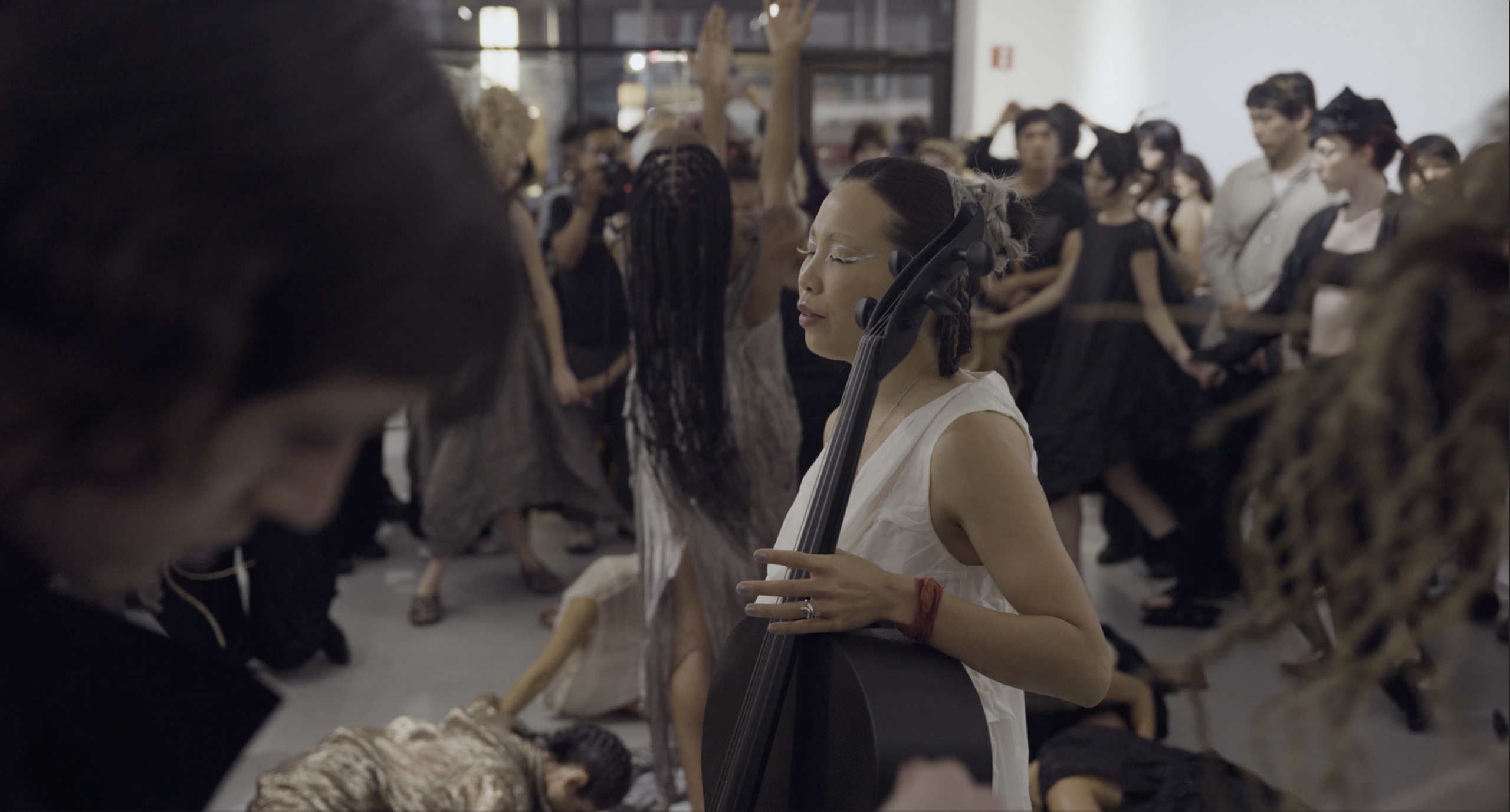
ACCELERATOR cohort member VORA (she/they) is a sonic and visual storyteller, integrating movement, visuals and sound in performances to illuminate themes of mysticism, deep ecology, and humanity’s imprint on nature. VORA is the founder and co-director of Water&Power, an artist-run community space in South LA serving emerging artists. They also curate VISCERA, an experimental performing arts show that bridges the gap between DIY and traditional performance art. We sat down at LAPP headquarters to learn more.
For those who don’t know you yet, how do you introduce yourself?
I’m Vora. I’m a composer, musician, performer, and community organizer. I think my most exciting project right now has been running the venue, music venue, and community space, Water&Power, really trying to champion electronic music and contemporary electronic music and performance art and the way those two have intersect and grow with technology.
How did you get to where you are today? What’s your origin story?
My father’s mother had a dream. She was an opera singer from North Korea. The legend we passed down in our family is that my grandmother’s mother was favored by the Lord, the North Korean Lord, and she was sent to Seoul to study opera singing. In Seoul, she was married off and then immigrated to the US. My dad, growing up, was very musical and yet at the same time very disconnected from his Korean culture and very traumatized in a lot of ways and wanting to be American. A lot of my practice is expressing that which I feel ancestrally wanted to be expressed but couldn’t be because of war, because of immigration, because of the pain of life, and doing so in a new way that helps others connect to their culture backwards in time and also forwards in time.
You’re a classically trained cellist and vocalist. What was that experience like? And how did you transition from classical music to more experimental electronic music?
I started music when I was in elementary school, middle school, and then from middle school I kept it up into high school, college, and beyond. But during that time, there was a period of time in my life where I was housing insecure between high school and in college and beyond. I had to give up music in order to focus on my survival and my basic needs. I then returned to it with a broadened perspective of what music was, and an introduction to electronic music. I got to re-emerge and dive back in as an adult, as a beginner in experimental music. I fell in love with the idea that you could make music anywhere without an instrument, without needing to carry things, without needing to study, with just found sounds. This was so freeing. From there, I started making electronic music, really for myself, and putting it out. And fell into a community of people who were making what is called deconstructed club music, and really taking traditional club music, house, techno break beats and warping it, manipulating it, changing it. Distorting it, stretching it. The people that are doing that within that community really inspire me.


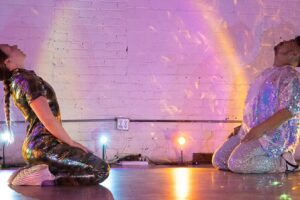
Photos by Lindsey Ruth
How did your practice then crossover to performance art? How did you come to performance art from a music background?
When you play an instrument, your body almost becomes part of that instrument. You co-resonate with that instrument in a way where you’re working together in this very physical partnership, like a dance. Then in electronic music when you perform, there’s a distinct lack of connection in that way, where you’re DJing on the decks and people are watching you and there’s visuals in the background. As soon as I started doing that, I really felt like that wasn’t enough for me. I wanted to have that physicality, that connection with the audience. That DJing route or that just playing live behind a computer route didn’t tell the story that I wanted to tell. I wanted more from that experience. So I started thinking about, along with a lot of my peers, how to immerse people in computer music, with something that’s more physical. That’s where performance came in, where movement and stage design and lighting are all working together to tell this narrative that maybe would only be accessible to you with headphones, you know?
When you’re creating a new piece, do the sonic elements come before the movement, the embodied part, or do they emerge simultaneously?
My inspiration for making work has always been deeply spiritual. I usually feel like I have a spiritual experience or theme or lesson that I have gone through and am trying to process. This can be something as simple as the concept of self-sabotage, the concept of self-abandonment and how that manifests. Or it can be as complex as exploring a past life experience or generational memory that feels unrelated, but you somehow have.
I’m hearing that spirituality inspires a lot of your work. What are some other themes that your work explores?
Growing up here in the US, I didn’t feel like my identity was very important. My parents were bullied for being Asian American, so they tried to hide and reject their Asian-ness, their Asian American-ness. So I never really thought it was important, where I came from, what my mother’s and my grandmother’s names were, what our stories were. It wasn’t until I was on my own journey of healing that those questions started to emerge and become important. I started to learn what my grandmother experienced before, many generations before I was even born. Her experiences are echoing into my body, into my memory, into the way that I respond to the world. I’m really interested in healing, in trauma, in ancestral memory, and the way that that information is communicated into the present day and what to do with it in a very abstract way, but also in a very real way. Like, how do we break these generational cycles? What do we do with these feelings? And I think one of the things that I found is being witnessed, being seen, and performance is one way to do that. So that’s why it’s important for me to perform and also to create spaces for people to perform.
When you’re exploring themes like trauma and generational… heaviness… how do you take care of yourself? How do you make it sustainable?
One of the largest things has been relying on my non-human allies. And that could be bodies of water. That could be the plants and the trees in my garden. That could be bees. That could be animals in my yard. I think this mode of receiving from the world around you has largely been cut off. When I think about resourcing myself, I think about allowing myself to receive that which is already present that I just cut myself off from. So I do that by spending time by myself, either in nature or in a beautiful place, and also spending a lot of time with water if I can.
That’s lovely. What I’m hearing is that you spent a lot of time alone, but not really alone because you’re with all of your non-human friends. But I was looking at your previous work and you’ve had a lot of artistic collaborators. So when do you spend time on your own and draw all the inspiration from the world, and when do you go out into the world and work with other artists?
I think at the core, all art should be about communicating and connecting. What’s in your heart and what’s on your heart. And it’s not fun for me as much unless there’s like a big group project. So I think usually I receive the concept or the idea, you know, maybe during a meditation or just during time outside, or I will, like, receive this idea or this concept, and then I’ll spend some time fleshing it out. And then the execution of the project is really when I am excited to bring in my collaborators and tell them, this is what I’m hoping to achieve, this is how I could use your help if you would like to. I’m asking them would you like to be a part of this vision? This is my dream, this is what I’m trying to achieve. Would you help me? And I’ve been really proud and grateful for the way people have supported the work.

Photo by Yamin Rashid
So, as a classically trained musician, you know, usually people perform in concert halls or chambers, churches. And a lot of your work doesn’t happen in those places. Why have you chosen the locations that you have chosen to present your work?
The architecture of each space reverberates differently and transmits a certain vibe, we might say, or feeling or energy, depending on which culture and lineage or what kind of language you like to use. Different spaces have different feelings. And my favorite place to perform is outside. It feels expansive and intense, sometimes scary, sometimes harsh. This rawness is something I think we try to protect ourselves from within an urban society. We try to make it more comfortable, make it more palatable, make it more soft and easier for ourselves, but all of the creatures that are living have no other choice, you know, and experience their environments all in this interconnected way. I would say I also consider this work very sacred. I would consider it very profound, where I see a temple or a lakeside or the back alley as all the same in a sort of way. They’re all places where people gather because they feel called to in their heart and have something they want to come together for. It’s a place where people can be wild and be free.
When you’re performing outside–a lot of people don’t do that because they want to block out all the noises, the wind, the birds. But when you are performing in nature, are those sounds all part of your music? Have you thought about it that way?
I think beyond the soundscape, I think of the landscape. As living. And I think of myself within the ecosystem all the time, really. And my sound is just one melody within the Earth song that is already playing.
When you’re not in nature, how do you incorporate your relationship with the Earth, with nature, into your performance, into your sound?
This year in particular, I have felt it really important to create a focal point with a theme. And the show that I curate is called VISCERA. I chose that name because I wanted to highlight the intensity and the rawness of those types of feelings that you may be feeling your body but can’t communicate or know but have no words for. And this year, two themes that I really enjoyed curating the show around were ‘water’ and ‘vessel.’ In WATER we installed a full-size aquarium tank which I danced in and performed on with chains hanging from the ceiling that wrapped around the tank going back up and fabric coming down to really create my vision of a water temple. And in VESSEL we also used a lot of lighting and a lot of fabric to shape the ambience and make it feel very intimate and make it feel very homey and warm. Vessel was about your body as a vessel for divinity and every living thing being a container for the spirit that comes and moves all beings. Whenever possible, I love to craft the space to support the theme or the ideology or the message.

Photo by Yamin Rashid
Is that the most recent project you’ve been working on?
Since starting our community space, Water&Power, having a venue has made it much easier to have shows indoors, obviously, and create these sort of curated shows. That’s been really exciting and also a way to invite other people to showcase their work because Viscera is a multimedia showcase. So we have performances, music throughout the night, but we also have sculpture on the walls. We also have paintings on the walls. All of these things come together to support the theme and tell that story, and yet each artist is also receiving their flowers for their particular piece. That’s probably my favorite part of that project, is how celebratory it is, how we can all come together, and there’s a big individual acknowledgement of that person’s work, but also an acknowledgement of the work in the context of this theme, or the work in the context of other people’s work and how it all comes together.
Are there any upcoming shows or performances?
In April 2026, the next V show will be in the theme of wu.
Wu. The Chinese.
That theme is talking about, in English, the translated concept of moving with flow or not resisting the natural path of life. I’ve been thinking a lot about that because so much of our suffering comes from resisting what is happening to us now and not responding from a place of acknowledging what is happening. I am going on an Asia tour in February and March so that’s why the next show will be in May. I got my first international booking from Busi Temple in Singapore and have a couple confirmed dates also in Hong Kong, Taiwan, and then now we’re working on Thailand. So that will be my biggest tour yet. And my first time in Southeast Asia.
What brought you to ACCELERATOR and how has it been going for you?
I think this year I really became aware of how funding works and the different ways that you could get funding. And part of the reason Water&Power decided to go non-profit was because I saw a long-term sustainable route for the type of performance work we want to make and also support as an organization. That being said, I think the model looks different than what it did in the past. I think in the past organizations could sustain more off of grants and more off of foundational sort of things and now, on the ground, I’m seeing a lot of need for at least our organization to be part business and part nonprofit because there is just no sustainability in a grants only approach, in a donations only approach. I have really enjoyed meeting LA Performance Practice, hearing from Miranda [Wright, LAPP Founder], and learning some of these basic skills.
I’ve been amazed at how resourceful people are, you know? People will be like, I can’t offer much, but I can offer a ride, or I can’t offer much, but I can help brainstorm, I can body double, you know, like these types of things that we definitely are socialized not to ask for. I think the more we get used to asking and the more we get used to receiving, just the faster we can help each other and move and get the things done that we need and get the resources that we need. And they’re there, you know, we just, if we don’t talk, we don’t know.
You recently had a jam session with [fellow ACCELERATOR cohort member] Joo. How did that happen?
Super simply. I said, oh my God, you play haegeum? I never heard of it before. She’s like, yeah. And I was like, you should come over and play. And we were like, yeah.
That’s so beautiful.
I love it. Because I just want to hear everybody’s work. I really want to know what people are doing, what their practice is and why it’s interesting to them.
I feel like, you know, in white supremacist, capitalist culture, we’re taught to protect ourselves and shut off from the rest of the world, not help others or, like, ask for help, but I feel like in this little community of ACCELERATOR, everyone, and I’m talking every single artist, is saying, I’m so excited to learn about each other’s work. I would love to be able to support other artists. I would love to collaborate with one another. So it doesn’t feel like a competitive environment of any sort. Very different from probably what the outside would perceive. That’s just that’s so rare. I love it.
I noticed in our last cohort meeting there was actually a huge need for people to share what was on their heart and to have the community listen and hold space for that and respond. There was a lot of pain. There was a lot of struggle. There was a lot of grief and transition and hurt. How validating to be heard and seen by other people, that you’re not struggling in this alone and that these are the real challenges. We need to hear this. We need to hear what we are actually struggling with. Not just, oh, this is how I’ve been able to get this funding. But also like, where did we get burned? Where did we face burnout? Where did we fail?
VORA (she/they) is a sonic and visual storyteller, integrating movement, visuals and sound in performances to illuminate themes of mysticism, deep ecology, and humanity’s imprint on nature. Rooted in vibrant experimentation, their work is guided by gratitude, reverence, and devotion for the divine. Their performance embodies an intensely animalistic, raw and spiritual force, centering the body as a vessel for direct connection to earth and spirit. Their practice emerges as a chimera of ballroom vogue, shamanism, music production and modern divination, transmuting mythologies of experiences within land, body and emotion. Using sound, sculpture and performance, they draw on ancestral traditions, folklore, and lived experience. VORA is the founder and co-director of Water&Power, an artist-run community space in arts-underserved South LA serving emerging artists. They also curate VISCERA, an experimental performing arts show that bridges the gap between DIY and traditional performance art. VORA received the highly competitive Rising Artist Grant, and was mentored by electronic musician and activist Nicolas Jaar. They have been commissioned and supported by organizations such as IO Music Academy, MTV Composing Program, and REACH LA.