By Jazz Zhu
ACCELERATOR is Los Angeles Performance Practice’s flagship artist development program—a nine-month intensive that empowers multidisciplinary artists to build sustainable, visionary, and self-determined creative careers. A thoughtfully-selected cohort of twelve Los Angeles-based artists meets bimonthly to engage in professional development workshops, in-depth mentorship, and peer accountability to design a resilient creative life. By the end of the program, participants will have artist statements that celebrate their whole selves, a personalized strategy for resourcing their practice, and a sustainable approach to producing the work they’re passionate about.
Cohort member Sharon Chohi Kim (she/her) is a performing artist and composer working at the intersection of immersive experimental opera, performance art, improvisation, sound art, and site-specific activation through movement and voice. She has composed and created performances for institutions such as the Museum of Contemporary Art (MOCA), LA Phil’s Insight series, and REDCAT. At the time of this writing, we are proud to announce that Chohi has just been named a recipient of the 2026 Creative Capital Award. Congratulations, Chohi!

Photo by Ruth Kim
For those who haven’t met you before, how do you introduce yourself?
I’m Sharon Chohi Kim, and I go by Chohi. I am a vocalist, artist, composer, and performer based in Los Angeles. I have a traditional opera background, but my work expands beyond that box. I collaborate across disciplines with visual artists, performers, composers, dancers, and actors. I began in theatre, so I’m used to the collective creative process.
How did you get to where you are today?
I grew up singing in the church choir. My dad was a choir conductor, and music was always a part of my life. I wanted to be a K-pop star, but my dad pushed me toward classical voice lessons. I cried for the first month, but I discovered a love for languages and poetry, which led me to opera school.
I still value opera deeply, but over time I became drawn to immersive, site-specific work and improvisation. After years of performing other artists’ work, I wanted to make what I wanted to make and perform in ways that felt more aligned with me.
Was there a moment that pushed you beyond traditional opera?
It was gradual rather than a single moment. Performing the role of Wiindigo in Sweet Land was important because it included improvisation alongside Raven Chacon’s written music. I loved exploring the character in depth, and I think of myself as an actor before a singer.
Playing the Hungry Ghost in Meredith Monk’s Atlas also inspired me. That integration of voice, movement, and composition in a single gesture felt aligned with how I want to work. My roles increasingly crossed into performance art, which is where I felt most engaged.
When you are making a new piece, what tends to come first?
I usually begin with a larger concept, such as systems in nature or animal communication. From there, I imagine sound and then create it. I’m drawn to electronic music, using synthesizers and found objects to shape the exact sound I want. Movement stems from the same inspiration. I am not formally trained as a dancer, so it emerges organically rather than through technique.
You’ve spoken about wanting to move outside the classical “box.” What does that box represent to you?
Western European classical music often comes with rigid limitations, including specific instruments, styles, and hierarchies where singers are often placed at the bottom. The character archetypes for women are especially narrow and outdated. We are either the damsel in distress or the crazy woman.
Race and ethnicity play a role as well. I have been in productions where people of color were cast as servants or villains while main roles went to white performers. I felt I had to work much harder to access the same opportunities as my white colleagues. Eventually, I realized I could no longer participate in those narratives.

Photo by Ian Byers-Gamber
Is there a project that represents where you are artistically right now?
Fiber, which I presented at MOCA Geffen, feels representative. I am still refining my voice, but that piece felt honest to who I am. It grew out of time spent alone in the desert and brings together voice, movement, electronics, and the musical language I am developing.
You became a mother in 2023. How has that experience affected your life and work?
Motherhood has been insane and wonderful. I’ve been embracing the shape-shifting power that I have as a woman. After giving birth, I pushed myself hard creatively, partly to affirm my continued presence as an artist. That period was physically difficult, and I am only now regaining my voice and strength. At the same time, I have been more productive creatively over the past few years than ever before.
What kinds of support do you wish were more available for artist parents?
There could be more practical support. Five-minute breaks are not enough when your basic needs compete with caregiving responsibilities. Family-friendly residencies are also rare. My ideal residency would offer safe, comfortable housing, childcare, and beautiful nature. Just a place where you can breathe. We already have so much to worry about.
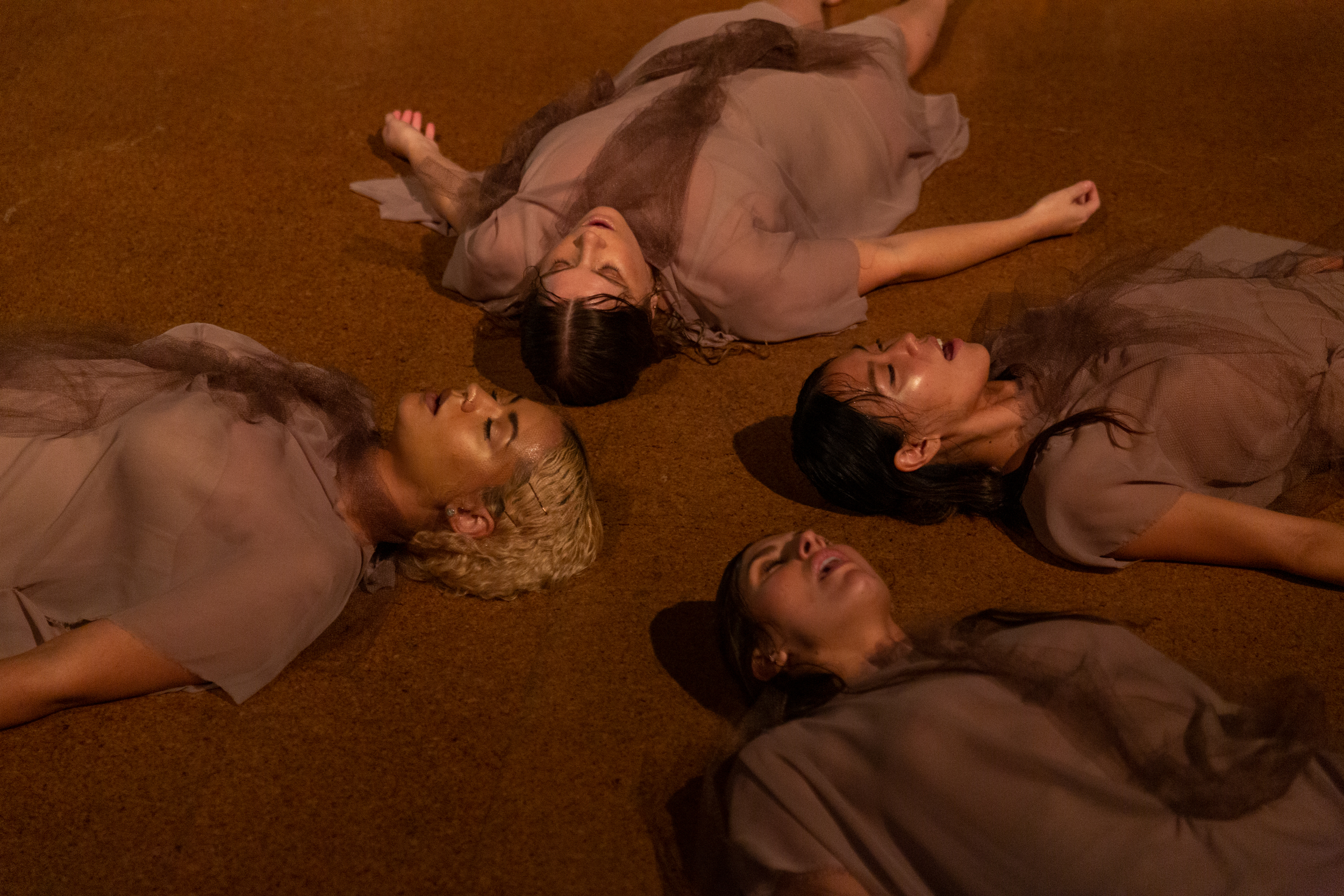
During your 2023 R+D residency with LAPP, you began developing Haenyeo, a hydro-opera. What drew you to this project?
I have always been drawn to water and marine life. When I learned about the haenyeo, the free-diving women of Jeju Island, I felt an immediate connection. Their traditions are rooted in shamanism and in close relationships with nature and water. Learning that they come from a matriarchal society, which is rare in Korea, made that connection even stronger.

Photo by Elon Shoenholz
How does Korean ancestry and cultural influence surface in your work?
I try to explore that part of myself in a way that feels true to who I am. Turning directly to traditional forms does not feel authentic, because I am Korean American. Instead, those influences tend to emerge unexpectedly, often through improvisation. Sometimes I watch a recording back and think, that feels very Korean, or I am drawn to an object like a large metal bowl and my mother asks why I am using a kimchi bowl in a performance.
Growing up, my relationship to Korean culture felt private. I spent summers watching K-dramas, reading manhwa, folding origami. Now that Korean culture is much more visible in mainstream Western media, it feels strange, like encountering my childhood from a distance. I am aware of contemporary K-pop and media, but I am still taking time to understand how or whether they enter my work.
Is there a central idea that recurs across your work?
I often return to the idea that humans are not separate or singular. We are porous and interconnected, made of the same matter as the environment around us. I do not see humans as superior to other forms of life.
What brought you to LAPP’s ACCELERATOR program at this point?
I have spent years moving from project to project without strong systems in place. While that freedom has value, I am seeking structure, guidance, and support. Asking for help has been difficult for me, but I recognize how necessary it is.
What sustains you right now?
Hope. Continuing to make work feels essential. There are moments of discouragement, but persistence feels necessary. Artists are adaptable and resourceful, and meaning can be communicated indirectly. Music, even without words, can be deeply political.

Photo by Angel Origgi

Sharon Chohi Kim (she/her) is a performing artist and composer working at the intersection of immersive experimental opera, performance art, improvisation, sound art, and site-specific activation through movement and voice. She has composed and created performances for institutions such as the Museum of Contemporary Art (MOCA), LA Phil’s Insight series, and REDCAT. Chohi’s notable opera performances include Meredith Monk’s Atlas with the LA Philharmonic, Sweet Land with The Industry Opera Company, and Polia and Blastema, premiered at Festival O22 by Opera Philadelphia. She has also performed with a wide range of institutions and ensembles, including the Getty Center, Hammer Museum, Walt Disney Concert Hall, The Industry, Long Beach Opera, Wild Up, Human Resources LA, Getty Villa, The Broad, LA Master Chorale, Berggruen Institute, Hollywood Bowl, LA Opera, Epoch Gallery, Four Larks, and HEX. Her work as a performer and composer has been featured in The New York Times, The New Yorker, KCET, KCRW, New Classic LA, SF Classical Voice, and the Los Angeles Times.